
How Toronto came to eat the way it does: the people, migrations and accidents that shaped the plate.
Key eras
-
1834, the city is incorporated as Toronto
Toronto was incorporated in 1834 from the British settlement of York; the harbour and Don River-side market gardens grew the food economy through the 1840s with Anglo-Scottish settlers, the St Lawrence Market established in 1803 the city's reference food hub from the beginning.
-
1850s, peameal bacon and the city's signature sandwich emerge
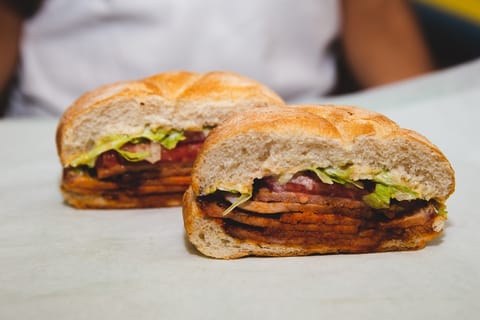
Peameal bacon, brine-cured pork loin originally rolled in yellow pea meal as a preservative, was developed in 1850s Toronto by William Davies for the British export market. Davies's Toronto pork-packing plant became the largest in the British Empire and earned the city the nickname Hogtown, with the peameal bacon sandwich at St Lawrence Market the surviving canon.
Taste it todayPeameal bacon sandwich -
1890s, Chinatown emerges on Spadina with Cantonese restaurants
Toronto's first Chinatown emerged in the 1890s along Elizabeth Street near old City Hall, displaced in the 1950s to make way for the new City Hall and rebuilt on Spadina between Dundas and College. By the 1970s Spadina Chinatown had over 100 Cantonese restaurants; Rol San (1994) and Mother's Dumplings (2005) the modern reference rooms on Spadina.
-
1960s and 1970s, post-war immigration builds Greektown, Little Italy and Little Portugal
Post-war Greek, Italian and Portuguese immigration through the 1960s and 1970s built the Danforth's Greektown, College Street's Little Italy and Ossington's Little Portugal. Cafe Diplomatico opened 1968 and Joso's 1967, the two longest-running rooms from this era; the Taste of the Danforth festival closes Danforth Avenue every August.
-
1970s and 1980s, Caribbean migration and the Jamaican patty
Caribbean migration through the 1970s and 1980s, primarily Jamaican and Trinidadian, established the patty shops along Bathurst, Eglinton West and Gerrard East. Patty King opened 1981 supplying convenience stores citywide; the Toronto-style coco-bread patty sandwich emerged as the city's most-eaten street food after the peameal bacon sandwich.
Taste it todayPeameal bacon sandwich -
2022, the Michelin Guide arrives in Toronto
The Michelin Guide arrived in Toronto in September 2022, the first Canadian city to receive an inaugural guide. Alo, Sushi Masaki Saito (two stars) and Edulis took stars in the inaugural; Quetzal added a star in 2024 as the city's first Mexican Michelin star; Sushi Masaki Saito was demoted to one star in the 2025 guide and retained one star in the 2026 guide.
Immigrant influences
- Cantonese and Hong Kong Chinese
- Spadina Chinatown's roast meat, dim sum and cha chaan teng kitchens since the 1890s; the Hong Kong wave of the 1970s-90s added fine dining at Lai Wah Heen.
- Italian-Canadian
- College Street's Little Italy since the 1950s, Cafe Diplomatico (1968) and Bitondo's (1960) the longest-running pizza counters; the Italian wave shaped Toronto espresso culture.Taste it todayCafe Diplomatico
- Greek
- The Danforth's Greektown built through the 1960s and 1970s; Astoria Shish Kebob House and Mezes the surviving line, plus the Taste of the Danforth August festival the country's largest Greek-Canadian food event.
- Caribbean (Jamaican and Trinidadian)
- Jamaican beef patties, jerk chicken and roti from the 1970s-80s migration. Patty King (1981) and The Real Jerk (1984) the surviving canon; Toronto patties are flakier than Jamaican.Taste it todayThe Real Jerk
- Portuguese
- Little Portugal on Dundas West from the 1960s, the Caldense Bakery on College (1992) the surviving counter for pastel de nata; the Portuguese diner-counter the precursor to the chef-driven Ossington strip.Taste it todayCaldense Bakery
- South Asian (Indian and Pakistani)
- Little India on Gerrard East built since the 1970s, Lahore Tikka House (1996) and Udupi Palace (1999) the longest-running; Thorncliffe Park is the Pakistani-Toronto hub since the 1980s.
- Korean
- Koreatown on Bloor West between Bathurst and Christie built through the 1980s-90s, Korean BBQ rooms and soondubu houses. Hodo Kwaja and Owl of Minerva anchor the strip.Taste it todayHodo Kwaja
Signature innovations
- Peameal bacon sandwich at Carousel Bakery in St Lawrence Market, the city's signature dish since the 1970sTaste it todayPeameal bacon sandwich
- The Caesar cocktail, invented in Calgary 1969 but adopted as Canada's national cocktail across Toronto barsTaste it todayCaesar cocktail
- The Toronto-style Jamaican patty, butter-flaky crust differing from the Jamaican original
- Butter tart, the Ontario gooey-runny pastry served at Wanda's Pie in the Sky since 1989
- Hawaiian pizza, invented in Chatham Ontario 1962 by Sam Panopoulos and claimed by Toronto chains as a Canadian originalTaste it todayHawaiian pizza
- Spaghetti pizza at College Street's pizzerias, an Italian-Canadian creation that travelled outside the city
- Korean fried chicken in Koreatown, the double-fried KFC introduced through Bloor West Koreatown in the 1990s
- Filipino-Toronto sisig at the Little Manila strip on Wilson Avenue, the chopped pork dish adapted for the city
Book food experiences in Toronto