How Sofia came to eat the way it does: the people, migrations and accidents that shaped the plate.
Key eras
-
Serdica (antiquity)
Sofia was known as Serdica in antiquity, and its recorded history begins with the Roman Republic's conquest of Serdica in 29 BC. The Roman-period remains uncovered in the basement of the Central Sofia Market Hall during its overhaul are a reminder that food was sold on this ground long before the present building.
-
Ottoman Sofia (1382 to 1878)
The Ottomans conquered the city in 1382, and from 1530 to 1836 Sofia was the regional capital of Rumelia Eyalet. Sixteenth century sources mention the largest bedesten (market) of the Balkans, fountains and hammams, and Bulgarian cuisine still carries a significant Ottoman contribution.
-
Capital of the new state (1879 to 1944)
Sofia was declared the national capital in 1879. Tomatoes reached Southeastern Europe in the mid-1800s and salads were adopted first by the urban population, and in 1909 to 1911 the city built its Central Market Hall to Naum Torbov's design.
-
Communist era (1945 to 1989)
In 1945 the communist Fatherland Front took power, and the capital had numerous factories producing goods that included food. The Central Market Hall was closed in 1988 for reconstruction, and the Balkantourist agency named its version of the salad shopska in 1956.
-
Reopening and festivals (2000 onwards)
The Market Hall reopened in 2001. By autumn 2025 Sofia Restaurant Week had reached its twelfth edition with 28 establishments, and the DiVino.Taste forum its fourteenth, with over 80 winemakers.
Immigrant influences
- Ottoman and Turkish
- Ottoman cuisine contributed to Bulgarian cooking, which shares a number of dishes with Middle Eastern cuisine, including moussaka, gyuvetch, kyufte, baklava, ayran and shish kebab. The Bulgarian name of tripe soup, škembe čorba, was borrowed from the Turkish işkembe çorbası.
- Greek
- Bulgarian cuisine shares a number of dishes with its neighbours, in particular Turkish and Greek cuisine, and shopska salad is a variation on a Greek salad of cucumbers, tomatoes and feta.
Signature innovations
- Shopska salad, named in 1956 by the Balkantourist agency, first appeared at the restaurant Chernomorets in the Druzhba resort near Varna and was approved as a national culinary symbol during the 1970s and 1980s
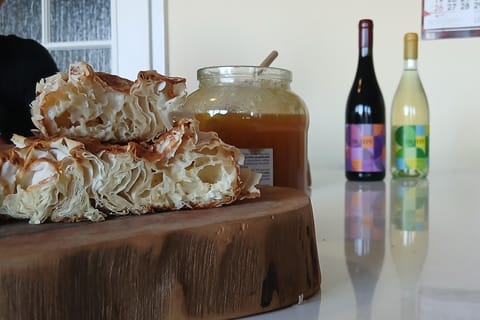
- Banitsa with lucky charms for New Year's Eve, a tradition that has recently grown to include wishes written on small pieces of paper wrapped in tin foilTaste it todayBanitsa (баница)
Book food experiences in Sofia