How Plovdiv came to eat the way it does: the people, migrations and accidents that shaped the plate.
Key eras
-
Thracian wine, 4000 BC onwards
The Plovdiv plain is one of the oldest continuously cultivated wine regions in Europe. Thracian tribes used local Mavrud-ancestor grapes for ritual and trade, with archaeological wine vessels dated to the 5th millennium BC.
-
Roman Trimontium, 46 AD to 5th century
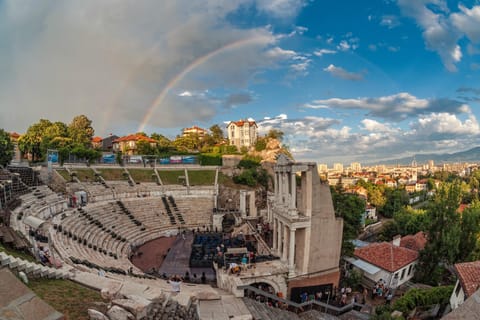
The Romans renamed the city Trimontium and laid the stadium, theatre and forum that still anchor the Old Town. Olive oil and Mediterranean trade routes through Trimontium connected the Bulgarian plain to Constantinople kitchens.
-
Bulgarian Revival, 1830 to 1878
Plovdiv was the cultural capital of the Bulgarian Revival. The Old Town's Revival merchant houses (Hindlian, Balabanov, Lamartine, Boris Palace, Alafrangite) hosted the salons that codified Bulgarian Revival cuisine.
-
Discovery of Lactobacillus bulgaricus, 1905
Bulgarian microbiologist Stamen Grigorov isolated Lactobacillus bulgaricus from Bulgarian yoghurt in 1905. The bacterium gives Bulgarian yoghurt its distinctive culture and made Bulgaria a yoghurt export power.
Taste it todayBulgarian yoghurt -
Shopska salad, codified 1955
Balkanturist, the Bulgarian state tourism agency, codified shopska salad in 1955 as the national salad to promote to foreign visitors: tomato, cucumber, raw or roasted pepper, onion, grated sirene cheese.
Taste it todayShopska salad -
Kapana revival and European Capital of Culture, 2014 to 2019
The Kapana trader's quarter, derelict since the 1990s, was reactivated as a creative district from 2014, supported by the Plovdiv 2019 Foundation. Plovdiv held the European Capital of Culture title in 2019, shared with Matera in Italy.
Immigrant influences
- Ottoman Turks
- Kebapche, kyufte, sarmi, baklava, Turkish coffee, ayran, sirene cheese all entered Bulgarian cooking during five centuries of Ottoman rule.
- Armenians
- The Plovdiv Armenian quarter near Sahat Tepe contributed pasterma cured beef, manti dumplings and Armenian bakery traditions still present on Knyaz Alexander.
- Sephardic Jews
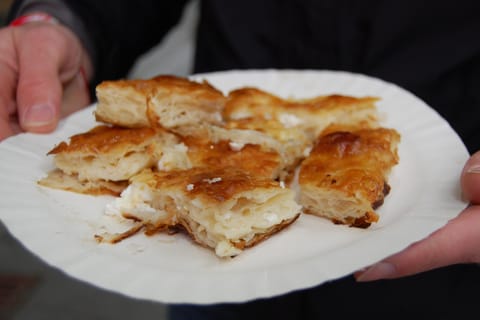
- Plovdiv's Sephardic community brought lentil burani, pickled aubergines, and the borek (bourekas) tradition that informs banitsa's modern variations.
- Greek Phanariots
- Greek Phanariot merchants in 18th-19th century Plovdiv anchored a wine and olive trade with the Aegean and codified the salads still recognisable today.
- Roma (Romani)
- Plovdiv's long-standing Roma community brought specific grilling, music and street food traditions to the city's markets and night-time grills.
Signature innovations
- Lactobacillus bulgaricus, the yoghurt culture discovered 1905
- Shopska salad, codified by Balkanturist 1955Taste it todayShopska salad
- Mavrud, the indigenous Thracian grape revived by Asenovgrad
- Banitsa with sirene, the Bulgarian phyllo standardTaste it todayBanitsa
- Kapana creative district as a food-led urban revival
- European Capital of Culture designation 2019
Book food experiences in Plovdiv

