How Antwerp came to eat the way it does: the people, migrations and accidents that shaped the plate.
Key eras
-
Medieval port city (12th-16th century)
Antwerp grew as a Hanseatic trade port through the Middle Ages. The Grote Markt's Stadhuis and the Cathedral of Our Lady rose between 1352 and 1521. Guild kitchens around the cathedral fed merchants from the Baltic, England and the Mediterranean. Spice trade routes brought saffron, pepper and ginger to local kitchens before they reached the rest of Northern Europe.
-
Spanish and Habsburg rule (1500s-1700s)
Spanish trade under Charles V routed silver from the New World through Antwerp's docks. Convent kitchens preserved waffle, speculoos and Flemish stew recipes. The cathedral's Lutheran iconoclasm in 1566 and Spanish reconquest in 1585 shifted population south; the Northern Netherlands took the trade, Antwerp shrank to a regional centre.
-
Brabo legend and Antwerpse handjes (1934)
The Brabo legend tells of the Roman soldier Silvius Brabo cutting off the giant Druon Antigoon's hand and throwing it in the Schelde, the act that gave Antwerpen its name. In 1934 pastry chef Jos Hakker turned the legend into a hand-shaped butter cookie, declared the city's official biscuit and still baked today by Philip's Biscuits and DelRey.
-
De Koninck and the Bolleke (1833 onward)
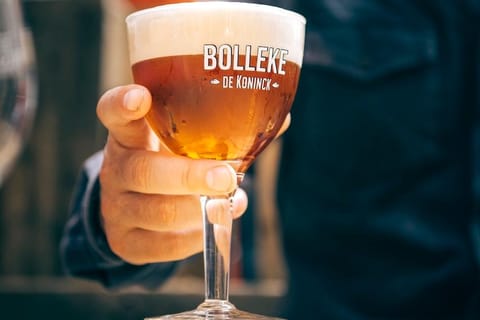
Brewery De Koninck opened on Mechelsesteenweg in 1833 and developed the Antwerp pale ale that became the Bolleke. The short-stem glass is the city's everyday beer signature. The brewery still operates from the original building, now also home to The Bakery and a complex of food retailers.
Taste it todayThe Bakery -
Diamond district and the Hasidic table (1880s onward)
From the late 19th century Hasidic Jewish diamond merchants concentrated around Pelikaanstraat and Lange Kievitstraat. Kosher Hungarian, Polish and Israeli kitchens grew with the community. Today Hoffy's, Kleinblatt and the strip of Pelikaanstraat counters serve the largest Hasidic population in Belgium.
-
Three-star Antwerp and post-2010 fine dining
Antwerp climbed the Michelin map after 2010. Viki Geunes earned three stars at Zilte on the MAS rooftop; Gert De Mangeleer reopened Hertog Jan inside the Botanic Sanctuary at two stars in 2021. Nick Bril moved The Jane in October 2025 from a deconsecrated chapel to a harbour location on Limastraat, where the room earned two Michelin stars in the 2026 guide.
Immigrant influences
- Hasidic Jewish (Diamantwijk)
- Antwerp's diamond district hosts the largest Hasidic community in Belgium. Hungarian, Polish and Israeli kosher kitchens cluster on Lange Kievitstraat and Pelikaanstraat.
- Moroccan and Turkish (Borgerhout)
- Borgerhout's Turnhoutsebaan strip runs Moroccan tagine counters, Turkish grills and halal butchers, the loudest weekend market in the city.
- Congolese and West African
- The Congolese trader presence dates to the 1950s. Matonge-style restaurants and groceries serve cassava, plantain and palm-nut stews across the Centraal Station area.
- Vietnamese
- BÚN and Little Bún brought refined Vietnamese cooking into the city; the kitchens lean into Belgian organic produce on Vietnamese templates.
Signature innovations
- Antwerpse handjes butter cookie, invented 1934Taste it todayAntwerpse Handjes
- De Koninck Bolleke pale ale poured in its short stem glass
- Zilte three Michelin stars in the MAS museum rooftopTaste it todayZilte
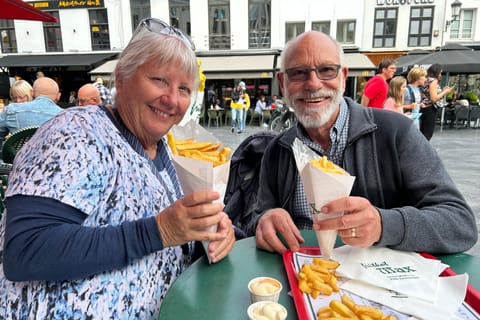
- Frites cooked in beef fat at Fritkot Max on Groenplaats since 1842Taste it todayFritkot Max

