How Salt Lake City came to eat the way it does: the people, migrations and accidents that shaped the plate.
Key eras
-
1847, Mormon pioneer arrival
Brigham Young and the first Latter-day Saint pioneers arrived in Salt Lake Valley July 24, 1847, beginning the agricultural foundation of the region. Pioneer diet emphasized self-sufficiency: stored grain, dried fruit, beehive honey and the wild sego lily bulb that sustained the first winter. The Pioneer Day holiday on July 24 still celebrates that founding meal with community BBQs and pioneer recipes.
Taste it todayPioneer Day BBQ -
1948, fry sauce invented
Don Carlos Edwards, founder of the Arctic Circle burger chain, invented fry sauce in 1948 by blending mayonnaise and ketchup at a customer's request at his Salt Lake counter. The sauce, sometimes with sweet pickle relish, became Utah's defining condiment, served at every burger counter from Crown Burgers to Apollo and integrated into the state's casual canon.
-
1978, Crown Burgers and the pastrami burger
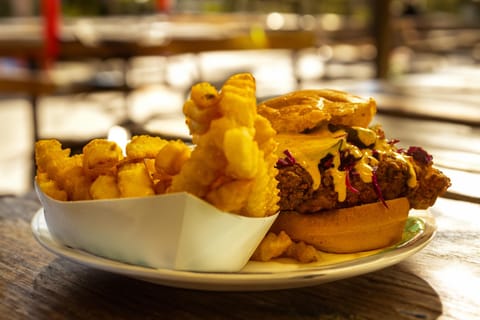
Nick Katsanevas and brother-in-law John Katzourakis converted a small hot-dog stand into Crown Burgers in 1978, eventually moving to 377 East 200 South. The signature Crown Burger, a quarter-pound cheeseburger loaded with pastrami, lettuce, tomato, onion and Thousand Island dressing, codified the Greek-Mormon pastrami burger now ubiquitous across Utah.
Taste it todayCrown Burgers -
1985, Red Iguana and Utah Mexican
The Cardenas family opened Red Iguana on West North Temple in 1985, building on their family Mexican restaurant tradition since 1965. The kitchen's seven to ten distinct moles, drawn from across Mexican regions, sit at the center of Utah's Mexican cooking. Red Iguana sits as Utah's most awarded restaurant and the city's defining Mexican destination.
-
1989, Squatters and Utah craft brewing
Squatters Pub Brewery opened on West Broadway in 1989 as Utah's first post-Prohibition brewpub, opening the door for the state's craft brewing industry. Under the state's 5% ABV draft limit, breweries innovate within constraints: Squatters spawned Wasatch, Salt Lake Brewing Co, and the family of breweries that anchor downtown's beer culture today.
Taste it todaySquatters Pub Brewery -
2009, Pago and farm-to-table
Scott Evans opened Pago at 9th and 9th in spring 2009 with a 45-seat dining room committed to local farms and artisan producers. The success of Pago codified Salt Lake's farm-to-table tier and gave rise to Evans' restaurant group including Finca, Casot and East Liberty Tap House, anchoring the city's modern fine-dining era.
Immigrant influences
- Greek Orthodox
- Greek immigrants arrived in waves from the late 1800s, building Holy Trinity Cathedral in 1925 and the Salt Lake Greek Festival in 1976. The community shaped Salt Lake's burger and tavern food.Taste it todaySalt Lake Greek Festival
- Mexican
- Mexican immigration from the early 20th century built North Temple and South Park Street's taqueria and grocery scene, with Red Iguana since 1985 as the editorial flagship.Taste it todayRed Iguana
- Italian
- Italian immigrants shaped Salt Lake's bakery and deli culture, with Tony Caputo's Italian deli since 1997 carrying the regional Italian and Southern European food tradition forward.
- Korean
- Korean immigration since the 1980s built a strong Korean BBQ and food-truck scene; Cupbop founder Junghun Song expanded a 2013 SLC food truck into a 60-state chain by 2025.
- Vietnamese and Laotian
- Vietnamese and Laotian refugees built strong noodle and street-food culture along State Street and South Salt Lake from the late 1970s onward.
Signature innovations
- Fry sauce - mayo-and-ketchup invented at Arctic Circle 1948Taste it todayFry sauce
- Pastrami burger - Greek-American hybrid codified at Crown Burgers 1978Taste it todayCrown Burgers
- Utah scones - fried bread served with honey butter
- Funeral potatoes - Mormon Relief Society casserole traditionTaste it todayFuneral potatoes
- Brandy whiskey - Wasatch craft distillery innovation
- Beehive symbolism - Brigham Young's industry icon on every label