How Milwaukee came to eat the way it does: the people, migrations and accidents that shaped the plate.
Key eras
-
1840s, German immigrant brewing arrives
German immigrants brought beer brewing to Milwaukee in the 1840s. Jacob Best opened the Empire Brewery in 1844; Frederick Pabst, Joseph Schlitz and Frederick Miller followed. By 1890 Milwaukee was the largest beer-producing city in America, and beer remained the city's signature export through Prohibition and the post-war years today.
-
1880, Usinger's sausage and Polish Hamtramck-style butchery
Fred Usinger opened the family sausage shop on Old World Third Street in 1880, importing German recipes and smoking bratwurst, knockwurst and Polish sausage for the city's growing immigrant population. Polish immigrants on the South Side opened their own sausage shops, including Maciolek and Sliwa, and bakeries that still bake paczki on Fat Tuesday in 2026.
-
1936, the butter burger at Solly's Grille
Kenneth Salmon, known as Solly, opened Solly's Coffee Shop in 1936 near Green Bay and Burleigh; the shop popularised the butter burger, a pat of butter on a fresh-griddled patty with stewed onions, and moved to North Port Washington Road in Glendale in 1971. The style spread to Sobelman's, Kopp's and other Milwaukee chains; the butter burger is now the city's signature dish for a casual lunch and counter dinner.
-
1942, Wisconsin frozen custard takes hold
Leon Schneider opened Leon's Frozen Custard on South 27th Street in 1942, and Elsa Kopp opened Kopp's in 1950 in Glendale. Wisconsin frozen custard, made from a high-egg-yolk recipe and churned slowly, became the city's defining dessert; both shops still operate with daily-rotating custard flavours and lines around the block in summer.
-
1960s onward, Wisconsin supper clubs and Friday fish fry
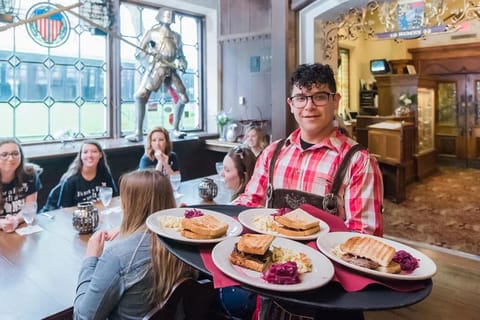
Wisconsin's Friday fish fry tradition, with origins in 19th-century Catholic Lent observance, hardened into a supper club ritual in the mid-1900s. Five O'Clock Steakhouse on West State Street has run since 1948; Lakefront Brewery's Friday fish fry hall with polka band became the city's defining version, with perch, cod, rye bread, coleslaw and a brandy Old Fashioned at the bar.
Immigrant influences
- German
- Brewing, bratwurst, beer halls. The Old German Beer Hall on Old World Third Street keeps the bier-hall tradition; Mader's serves classic German since 1902.
- Polish
- South Side pierogi, paczki on Fat Tuesday, kielbasa. New Palace Bakery and Lincoln Village delis carry the tradition; Polish Fest at the lakefront is the largest in the US each June.Taste it todayPolish Fest Milwaukee
- Italian-American
- Brady Street is the city's Italian neighborhood: Peter Sciortino's Bakery and Glorioso's Italian Market anchor it since 1948. Festa Italiana on the lakefront runs three days each July.
- Serbian
- Bay View's Three Brothers, in an 1897 Schlitz tied house, is a James Beard America's Classic Serbian tavern run by the Radicevic family since 1956.
- Mexican-American
- Walker's Point and the South Side run dozens of taquerias along Cesar Chavez Drive and West Lincoln Avenue; Mexican Fiesta at the lakefront draws crowds each August.
- Hmong
- Fondy Farmers Market on the North Side runs a deep Hmong grower contingent, with specialty produce including lemongrass, bitter melon and Asian greens since the 1990s.Taste it todayFondy Farmers Market
Signature innovations
- Butter burger, popularised at Solly's Grille in 1936
- Wisconsin frozen custard, dense from slow churning, at Leon's since 1942Taste it todayWisconsin frozen custard
- Wisconsin Old Fashioned with brandy instead of whiskeyTaste it todayWisconsin Old Fashioned
- Friday fish fry as a city social mealTaste it todayWisconsin Friday fish fry
- Cream puff vendor at Wisconsin State Fair, every August since 1924