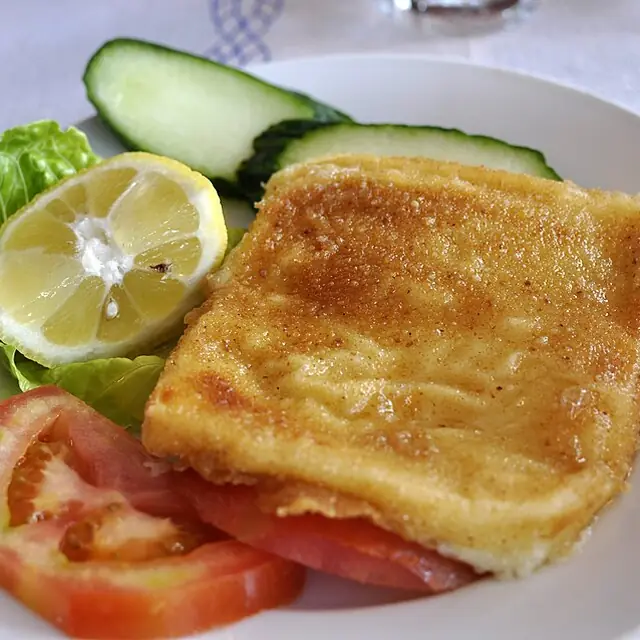
Detroit Greektown's signature theatre dish: a thick slab of Kasseri cheese dredged in flour, pan-fried golden, doused in brandy and ignited tableside with a shouted Opa. Eaten with lemon and torn pita.

Flaming saganaki was invented at the Parthenon restaurant in Chicago's Greektown in 1968, when owner Chris Liakouras lit the fried Kasseri tableside at a customer's suggestion; the format spread through Midwest Greek-American restaurants in the 1970s. Detroit's Greektown, anchored on Monroe Street since the late 19th century by Greek immigrant families, adopted the flaming presentation early and made it a fixture of the neighborhood's dinner theatre. Pegasus Taverna on Monroe Street runs the canonical Detroit Greektown version with the Opa shout from servers.

Where to eat Greektown Saganaki (Flaming Kasseri) in Detroit

2 editor picks for Greektown Saganaki (Flaming Kasseri) in Detroit, ranked by editorial score. All Detroit signature dishes · Greektown Saganaki (Flaming Kasseri) across every city.

Book food experiences in Detroit

See all 112 food experiences in Detroit

More places near Astoria Pastry Shop and Pegasus Taverna

Not on this list, but close by, nearest first. Every one is in our guide with its address, hours and what to order.

Make it at home

Serves 215 minEasy

Ingredients

  • 200g Greek Kasseri cheese, cut into a single thick slab (about 2cm thick, 8cm by 12cm; or substitute with Kefalograviera, Halloumi or Provolone if Kasseri unavailable)
  • 50g all-purpose flour for dredging
  • 1 large egg, beaten
  • 1 tbsp ouzo or brandy (in the egg, for flavour)
  • 3 tbsp olive oil for frying
  • 60ml brandy or Metaxa Greek brandy (for the flaming step; the higher the proof, the better the flame)
  • 1 lemon, cut into wedges
  • 4 to 6 pita breads, warmed
  • Fresh oregano leaves and cracked black pepper
  • A long match or kitchen torch for the ignition (essential)
  • 1 small heavy iron skillet (saganaki pan; a small cast-iron pan works perfectly)

Method

  1. Pat the Kasseri slab very dry on a clean tea towel; dust evenly on all sides with flour, shaking off the excess.
  2. Beat the egg with 1 tbsp ouzo or brandy in a shallow dish.
  3. Heat the olive oil in a small heavy iron skillet (the saganaki pan; this is the structural step, the cheese will be served in the same pan in which it was cooked) over medium-high heat until shimmering.
  4. Dip the floured cheese briefly in the beaten egg, lift out letting the excess drip back.
  5. Lay the cheese in the hot oil; do not move it for 60 to 75 seconds, until the underside is deep gold and crisp.
  6. Flip the cheese with two thin spatulas and cook the second side for 45 to 60 seconds; the cheese should be just slightly soft in the centre but the exterior crisp and golden.
  7. Slide the pan off the heat, leave the cheese in it (the pan goes to the table).
  8. Warm the brandy briefly in a small saucepan (do not boil), about 20 seconds until just warm.
  9. Bring the hot pan with the cheese to the table immediately. Pour the warm brandy over the cheese.
  10. Strike a long match (or use a kitchen torch) and light the brandy; it should erupt into a tall blue flame for 8 to 15 seconds.
  11. While the cheese still flames, shout Opa! (the Detroit Greektown convention is non-negotiable).
  12. Squeeze a fresh lemon wedge over the still-flaming cheese; the citric acid extinguishes the flame instantly and adds a structural sour note to the dish.
  13. Serve immediately, with the diners tearing pieces of warm pita and scooping the soft fried cheese directly from the pan.
  14. Scatter with fresh oregano leaves and cracked pepper.

Editor tip. Greek Kasseri is essential for the canonical Detroit-Greek-Town version; it is a semi-hard sheep-milk cheese that fries to a golden crust while remaining slightly soft inside. Halloumi works but stays firmer. The brandy ignition is theatre but also functional; the alcohol flash burns off and leaves only the aromatic notes.

Common allergens: Dairy, Gluten.