How Valletta came to eat the way it does: the people, migrations and accidents that shaped the plate.
Key eras
-
Arab and Sicilian roots (870 to the 11th century)
Imqaret, deep-fried date pastries, are of Arabic origin and were introduced during the Arab period on the island between 870 AD and the 11th century. Italian, specifically Sicilian, Middle Eastern and Arab foods exerted a strong influence on Maltese cooking.
Taste it todayImqaret -
The Knights of St John (1530 to 1798)
The Order of Saint John was based in Birgu from 1530 to 1571, and Valletta was founded in 1566 and became the capital on 18 March 1571. The Knights hailed from France, Italy and Spain, their contacts and wealth brought food from the New World, and aljotta is the Maltese adaptation of bouillabaisse. Stuffat tal-fenek, rabbit stew, quite possibly began as symbolic resistance to the Knights' hunting restrictions and became popular after they were lifted in the late 18th century.
-
French rule (1798 to 1800)
In 1798 the French invaded the island and expelled the Order. French troops continued to occupy Valletta and the harbour area until they capitulated to the British in September 1800.
-
British garrison and The Gut (from 1800)
The British military presence meant a market of a garrison and their families, and English mustard, Bovril, HP Sauce and Worcestershire sauce remain a subtle but pervasive presence in Maltese cooking. Strait Street, known to British sailors as The Gut, was full of bars, and jazz came to Malta there.
-
Capital of Culture and UNESCO ftira (2018 to 2026)
Valletta was European Capital of Culture in 2018, the year the covered market Is-Suq tal-Belt reopened renovated. In 2020 the Maltese ftira was added to UNESCO's Intangible Cultural Heritage List, and the Valletta Local Food Festival reached its fifth edition in July 2026.
Immigrant influences
- Arab
- Imqaret, the diamond-shaped date pastries flavoured with aniseed and bay leaf, are of Arabic origin.
- Sicilian and Italian
- Italian influences are strong, and timpana, whose name probably derives from timballo, is the pasta-in-pastry dish of festive tables. Kannoli, tubes of crispy fried pastry filled with ricotta, are a favourite dessert.
- French and Provençal
- French and Provençal cooking reached Malta with the Knights. Aljotta is the Maltese adaptation of bouillabaisse, and the Maltese word aljoli is a variation on aioli.
- Spanish
- Spain is one of the countries the Knights came from, and it has been suggested that Malta was one of the first countries in Europe, after Spain, where chocolate was tasted.
- British
- British products such as English mustard, Bovril, HP Sauce and Worcestershire sauce stayed in Maltese kitchens, and tea in a glass, te fit-tazza, is a local variety of builder's tea.
Signature innovations
- Kinnie, the bittersweet soft drink brewed from bitter oranges and wormwood, first produced by Simonds Farsons Cisk in 1952
- Qagħaq tal-għasel, honey and treacle rings made for Christmas, now baked all year round
- Ftira, the ring-shaped leavened Maltese bread, listed by UNESCO in 2020 as the culinary art and culture of flattened sourdough bread in MaltaTaste it todayFtira
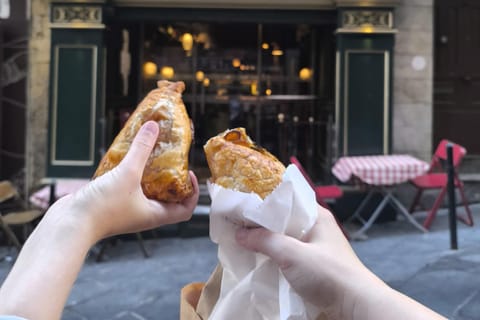
- Pastizzi with limited-edition ricotta and truffle, Maltese sausage or Nutella fillings beside the traditional ricotta and peaTaste it todayPastizzi