How Kolkata came to eat the way it does: the people, migrations and accidents that shaped the plate.
Key eras
-
Company capital and exiled courts (1757 to 1858)
Kolkata was the capital of British-ruled India under the East India Company from 1757 to 1858. Exiled nawabs, notably the family of Tipu Sultan and Wajid Ali Shah of Awadh, brought hundreds of cooks and spice mixers to the city.
-
Colonial sweets and Western shops (1850s to 1900s)
The sponge rosogolla dates to 1868 and the ledikeni is said to have been made for Lady Canning during her stay in India from 1856 to 1861. Many Western food shops opened in Kolkata, and New Market, the first municipal market, opened on 1 January 1874.
-
Tea rooms and kebab rolls (1920s to 1930s)
Flurys opened on Park Street in 1927 and the kathi roll is said to have begun at the Nizam Restaurant, a Mughlai eatery founded in 1932.
-
Park Street nights (1940s to 1980s)
From the 1940s to the late 1960s Kolkata's night life centred on Park Street, and in the 1970s and 1980s many clubs and restaurants there hosted noted musicians.
Immigrant influences
- Mughal and Awadhi courts
- Persian and Arabic cuisine arrived with the Mughals, and korma and bhuna reached lower and middle class tables through court cooks. Wajid Ali Shah's kitchen in exile in Calcutta is credited with Kolkata biryani, with potato added.
- Chinese (Cantonese and Hakka)
- The first Chinese settler, Tong Atchew, founded a sugar mill near Kolkata in 1778. Hakka Chinese found their niche as cobblers and tanners, and restaurant work was popular among all groups; Tangra and Tiretta Bazaar still hold the city's Chinese restaurants.
- Swiss and Italian
- Flurys was opened by the Swiss partners Joseph Flury and Quinto Cinzio Trinca, and Trinca later opened Trincas at 17 Park Street. Tiretta Bazaar is named after Edoardo Tiretta, an Italian immigrant from Venice.
- Baghdadi Jewish
- Nahoum & Sons in New Market was founded by Nahoum Israel Mordecai, a Baghdadi Jew, and its Christmas products are part of Kolkata's culture.
- Marwari
- Bhagwandas Bagla, a Marwari businessman and customer of Nobin Chandra Das, popularised the Bengali rosogolla beyond the shop's locality by ordering huge amounts.
Signature innovations
- Spongy rosogolla, made by Nobin Chandra Das in Sutanuti (Bagbazar) in 1868 by boiling chhena and semolina in syrupTaste it todayRosogolla
- Canned rosogolla, after Krishna Chandra Das introduced vacuum packing in 1930Taste it todayRosogolla
- Kathi roll, said to have started at the Nizam RestaurantTaste it todayKathi Roll
- Potato in biryani, the signature of Kolkata biryaniTaste it todayKolkata Biryani
- Ledikeni, a fried chhena and flour ball in syrup named after Lady CanningTaste it todayLedikeni
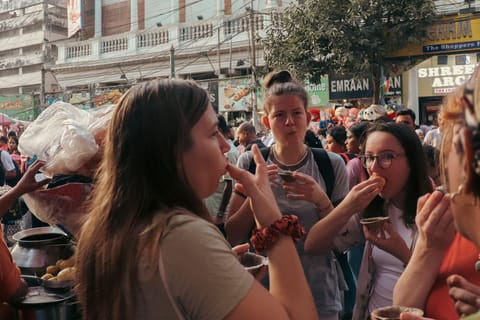
- Kolkata-style phuchka, with mashed potato and a sour, citrusy water, often flavoured with gondhoraj limeTaste it todayPhuchka