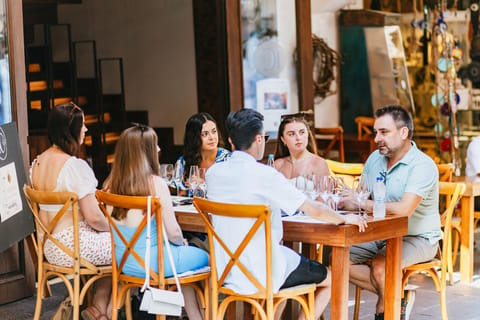
How Rhodes came to eat the way it does: the people, migrations and accidents that shaped the plate.
Key eras
-
Knights of Saint John (1310 to 1522)
The Knights of Saint John ruled Rhodes from 1310 to 1522, and under them the city was rebuilt as a model of the European medieval ideal.
-
Ottoman rule (1522 to 1912)
Rhodes fell to Suleiman the Magnificent in December 1522 and was then a possession of the Ottoman Empire for nearly four centuries. Kahal Shalom, the oldest synagogue in Greece, was established in the Old Town in 1557.
-
Italian rule (1912 to 1947)
Italy seized Rhodes in 1912, and thousands of Italian colonists settled on the island, mainly in the capital. The Nea Agora market at Mandraki dates from this period.
-
Union with Greece (1947 onwards)
The Dodecanese were ceded to Greece in 1947.
Immigrant influences
- Italian
- Thousands of Italian colonists settled on Rhodes after 1912, mainly in the capital.
- Jewish
- The Jewish community of Rhodes goes back 2,300 years, and its quarter in the Old Town holds the oldest synagogue in Greece.
- Frankish, Venetian and Ottoman
- Franks, Venetians, Ottomans and Italians governed Rhodes on and off, and Rhodian cooking blends their influences with Greek food.
Signature innovations
- Matsi, Rhodian pasta: Rhodes had its own local pasta tradition before the Italians arrived; matsi is made with semolina, egg, milk and salt.
- Gemista with bulgur: Rhodian stuffed vegetables are filled with bulgur rather than rice.
- Takakia from Archangelos: Takakia, also called mantinades, are rolled pastry pieces filled with nuts and spices, baked and soaked in honey syrup; they come from the village of Archangelos.Taste it todayTakakia (mantinades)
Book food experiences in Rhodes