The plates that define Hurghada: what they are, where they came from, and where to eat the canonical version.
Signature dishes
-
Grilled Red Sea fish
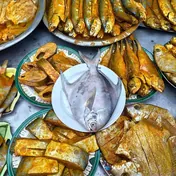
Hurghada's fishermen land their catch at Halaqat el-Samak in Sakkala, where barracuda, white sigan, hareed and shoor are sold by the kilo, daily from 9am to 10pm.
Price: At the Sakkala fish market in January 2026: white sigan EGP 150 a kilo, small hareed and shoor about EGP 180, barracuda EGP 220
Hurghada began in the late 19th century as a fishing village of Ababda fishermen around a natural harbour in Sakkala. In 2020 Egypt Today called the fish market the departure and arrival station of the city's fishermen, a place that tells the history of the city. A rebuilt Halaqat el-Samak of 6,370 square metres, with 54 display stalls, 9 shops and an ice factory, opened in December 2022.
Watch out for: Fish
-
Sayadeya
Sayadeya is fish with rice cooked with caramelized onions and aromatic spices, usually Egyptian short-grain rice, a staple beside seafood on Egypt's fishing coasts.
The name comes from the Arabic sayad, fisherman. It began as a fisherman's meal on the Mediterranean coasts of Egypt, Syria, Palestine and Lebanon, and an 1890 cookbook by the Lebanese author Khalil al-Khuri gives three recipes for it. In Egypt sayadiya is a staple accompaniment to seafood, especially in coastal regions where fishing is integral to the local economy and culture.
Watch out for: Fish, Tree nuts (almonds and pine nuts as garnish)
-
Koshary
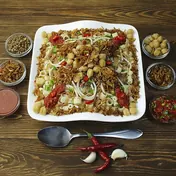
Koshary is Egypt's national dish and a popular street food: pasta, rice, vermicelli and brown lentils topped with chickpeas, a garlicky tomato sauce, garlic vinegar and fried onions.
In 1853 the explorer Richard Burton recorded koshary as the breakfast of the people of Suez, made of lentils, rice, butter, onions and pickled lemons, thought to be the earliest English written reference to it. Koshary was first sold from food carts and only later in restaurants. In 2025 UNESCO inscribed koshary, daily life dish and practices associated with it on its Representative List of intangible cultural heritage.
Watch out for: Gluten (pasta and vermicelli)
Book food experiences in Hurghada


-
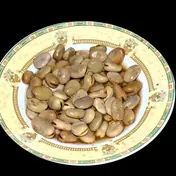
Ful medames
Ful medames is a stew of cooked fava beans with olive oil and cumin, often with parsley, garlic, onion and lemon juice, always eaten with bread; Egypt counts it a national dish.
Some writers trace ful medames back to Ancient Egypt, and the dish is mentioned in the Jerusalem Talmud. It is traditionally made in and served out of a large metal jug. Once cooked, the beans are salted and eaten plain or with oil, butter, fried or boiled eggs, tahini, lemon juice or chili peppers.
Watch out for: Gluten (in the bread), Sesame (when served with tahini), Egg (when served with eggs)
-
Ta'ameya
Ta'ameya is Egypt's falafel: deep-fried fritters made from fava beans rather than chickpeas, eaten at breakfast on their own or in a pita sandwich with tehina and greens.
Falafel is a fritter of Egyptian origin. In Egypt it is most often made with fava beans, while in the Levant it is typically made with chickpeas. Egyptian falafel was served, with feteer meshaltet, to US President Barack Obama during his visit to Egypt in June 2009.
Watch out for: Gluten (pita), Sesame (tehina)
-
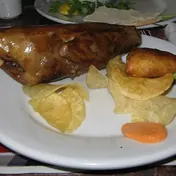
Hamam mahshi
Hamam mahshi is pigeon stuffed with rice or green wheat and herbs, boiled until cooked and then roasted or grilled; in Egypt it is a dish for guests and celebrations.
Hamam mahshi has been a staple of Egyptian cuisine for centuries and is associated with special occasions and gatherings. Serving it is a gesture of hospitality and respect, often kept for esteemed guests, because the preparation is careful work: the stuffing is usually part-cooked rice or freekeh mixed with grated onion, chopped chicken or pigeon livers and spices such as cinnamon.
Watch out for: Gluten (when stuffed with freekeh)
-
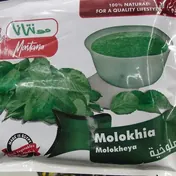
Molokhia
Molokhia is a green soup of very finely chopped jute mallow leaves with garlic and coriander, cooked in chicken broth; rabbit and shrimp broths are also used.
Jute leaves were eaten in ancient Egypt, and a recipe for the dish appears in the 14th-century Egyptian cookbook Kanz al-Fawa'id. Molokhia originated in Egypt and spread across the Middle East, North Africa and the Levant. When boiled, the leaves give a thick, mucilaginous broth, and in Egypt they are turned into a soup or stew that bears the same name as the vegetable.
Watch out for: Crustaceans (when made with shrimp broth)
-
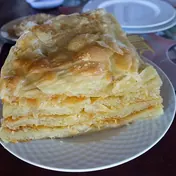
Feteer meshaltet
Feteer meshaltet is a flaky Egyptian pastry of many thin layers of dough and ghee, eaten sweet with honey, molasses or jam, or savoury with mish cheese, olives and torshi.
Feteer meshaltet dates back to ancient Egypt, where it was known as maltoot and placed in temples as an offering to the gods. Meshaltet means thin and flat in Egyptian Arabic. It is a symbol of hospitality, offered to guests and made for holidays and weddings, and it was served to US President Barack Obama with Egyptian falafel in June 2009.
Watch out for: Gluten, Milk (ghee)
-
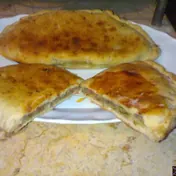
Hawawshi
Hawawshi is flat Egyptian bread filled with minced meat spiced with onions, pepper, parsley and sometimes chillies, then baked in the oven, made at home and sold mostly to take away.
Price: EGP 30 to 100 at restaurants, by size and amount of meat
According to one story, a Cairo butcher named Ahmed al-Hawawsh invented hawawshi in 1971 at his stall in the Souk Al-Tawfik neighborhood, and it spread from Cairo to the rest of Egypt. Other stories tie it to a 13th-century recipe in Ibn al-Adim's cookbook. In Alexandria the filling is baked between two circular layers of dough instead of inside the bread.
Watch out for: Gluten
-
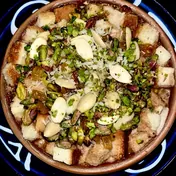
Umm Ali
Umm Ali is Egypt's national dessert, a bread pudding served hot and made with puff pastry or rice, milk, coconut and raisins, and commonly eaten at the Ramadan iftar.
The dessert is traced back to medieval Egypt. The most cited story ties it to the 1257 death of Shajar al-Durr, after which Om Ali, the first wife of the sultan Aybak, asked for a dessert to be made in celebration. No historical evidence connects the dessert to the legend, and the first known recipe dates only from the 19th century.
Watch out for: Gluten, Milk, Coconut
-
Jabana (Ababda coffee)
Jabana is the coffee of the Ababda and the Beja, made with roasted coffee beans and ginger; Ababda fishermen were the first to settle Hurghada's natural harbour at Sakkala.
The Ababda are an Arabized Beja tribe. Historically most were nomads between the Nile and the Red Sea, ranging from Halayeb to Hurghada on the coast, and Ababda fishermen settled the natural harbour at Sakkala in the late 19th century. Jabana is one of the most important parts of Ababda and Beja culture, alongside dances such as the Shakreeb and Hosheeb.
-
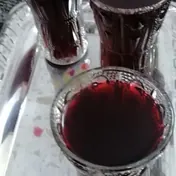
Karkadeh
Karkadeh is a tea of dried hibiscus sepals, served extremely sweet and cold, or sometimes hot, and one of the herbal teas most often poured at Egyptian teahouses.
Ancient Egyptians revered karkadeh as a restorative drink, sometimes called the Tea of the Pharaohs, and valued its red pigment for dyes and ceremonies. In Egypt and Sudan wedding celebrations are traditionally toasted with a glass of hibiscus tea, and on a typical Cairo street many vendors and open-air cafes sell the drink.
Signature Dishes in Hurghada, FAQ
What food is Hurghada known for?
Hurghada's signature dishes include Grilled Red Sea fish, Sayadeya, Koshary, Ful medames, Ta'ameya. See our signature dishes chapter for where to eat each.