History

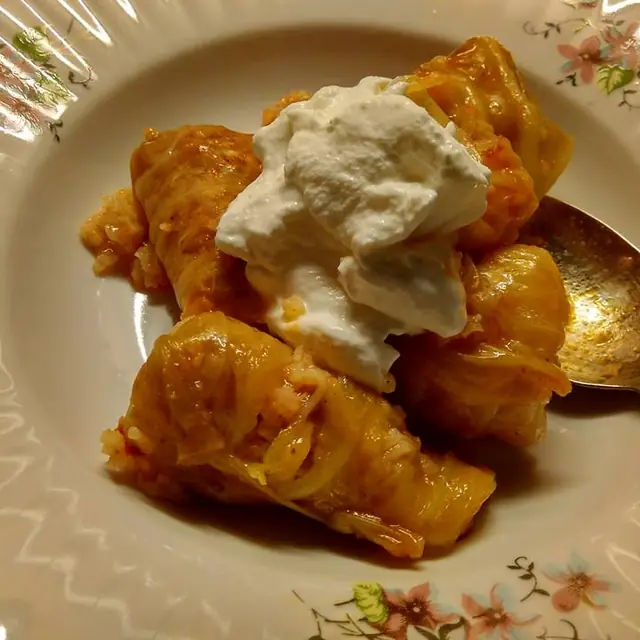
Stuffed cabbage in central Europe predates Hungary itself, but the Hungarian paprika-sauerkraut version is the local signature. The Christmas Eve serving is the canonical context; the dish appears year-round on Hungarian comfort menus and is traditionally eaten on the second day after cooking when the flavours deepen.

Common allergens: Gluten (in the stuffing)

Make it at home

Yield 6Hands-on 1 hrTotal 3 hrDifficulty Intermediate

Ingredients

  • 1 large head sour-fermented sauerkraut whole-leaf (savanyú káposzta), available at Hungarian or Polish delis
  • 1kg sauerkraut, drained
  • 500g minced pork (preferably 70% lean, 30% fat)
  • 100g long-grain rice, uncooked
  • 1 large onion, finely diced
  • 60g lard
  • 3 garlic cloves, minced
  • 2 tablespoons sweet Hungarian paprika
  • 1 teaspoon dried marjoram
  • 1 egg
  • 300g smoked pork ribs or smoked sausage (optional but traditional)
  • Salt and black pepper
  • 300ml full-fat sour cream to serve

Method

  1. Carefully separate the whole sour cabbage leaves; trim the thick central rib so they roll easily.
  2. Soften the diced onion in 30g of the lard for 10 minutes. Set aside half for the filling.
  3. For the filling: combine pork, rice, half the softened onion, 1 minced garlic clove, 1 teaspoon marjoram, the egg, 1 tablespoon paprika and seasoning. Mix well.
  4. Place a heaped tablespoon of filling on each cabbage leaf, fold the sides in and roll tightly. Repeat for all rolls (about 16 to 20).
  5. Spread half the drained sauerkraut on the base of a heavy casserole. Arrange the rolls seam-side down on top. Tuck the smoked ribs or sausage between rolls. Cover with the remaining sauerkraut.
  6. In a small pan, heat the remaining lard, off the heat stir in the remaining paprika and minced garlic, then add 400ml water and the remaining onion. Pour over the rolls until just covered.
  7. Cover and simmer over the lowest heat for 2 hours. Do not stir.
  8. Lift the rolls onto plates with a slotted spoon. Spoon sauerkraut alongside, drizzle the sauce, top with a generous spoon of sour cream.

Tip from the editors. Töltött káposzta improves enormously on the second day. Make a day ahead and reheat gently; the flavours deepen overnight.

Where to eat töltött káposzta

Töltött káposzta in Budapest

Hungarikum Bisztró ★ 4.5

Traditional Hungarian$$lipotvarosMon-Sun 12:00-14:30, 18:00-22:00

Hungarikum Bisztro on Steindl Imre near Parliament cooks the canonical Hungarian classics, with goulash, chicken paprikash and stuffed cabbage in a tiny.

Signature: Goulash soup, Chicken paprikash

Order: The chicken paprikash with house nokedli and cucumber salad.

Tip: Online reservation only; the small room books out for both lunch and dinner.

Gettó Gulyás ★ 4.4

Traditional Hungarian$$erzsebetvarosMon-Tue 12:00-22:30; Wed 12:00-23:00; Thu-Fri 12:00-23:45

Getto Gulyas on Wesselenyi cooks 14 varieties of Hungarian stews alongside Jewish-Hungarian classics in a tiny ghetto-era room in the Jewish Quarter.

Signature: Beef goulash, Rooster pörkölt

Order: The rooster pörkölt with nokedli; the Jewish egg paste as a starter.

Tip: Tiny room, no walk-ins after 19:00; reserve a day ahead Walk-ins usually OK.

Frici Papa Kifőzdéje ★ 4.1

Modern Hungarian$$terezvarosMon-Sat 11:00-22:00, Sun closed

Frici Papa on Kiraly utca has run a kifozde with shared tables and no English menu since 1997, a Budapest lunch room locals send friends to for under 3,000.

Order: Whatever is on the day's blackboard; point at the dish behind the counter.

Why locals love it: Sticky shared tables, no English menu and the cheapest sit-down Hungarian lunch on Király utca.

Tip: Cash preferred; no reservations and quick turnover at lunch, no English menu.

More cities are in research. Want töltött káposzta covered somewhere specific? Tell us where you want to eat.

Browse all dishes →