History

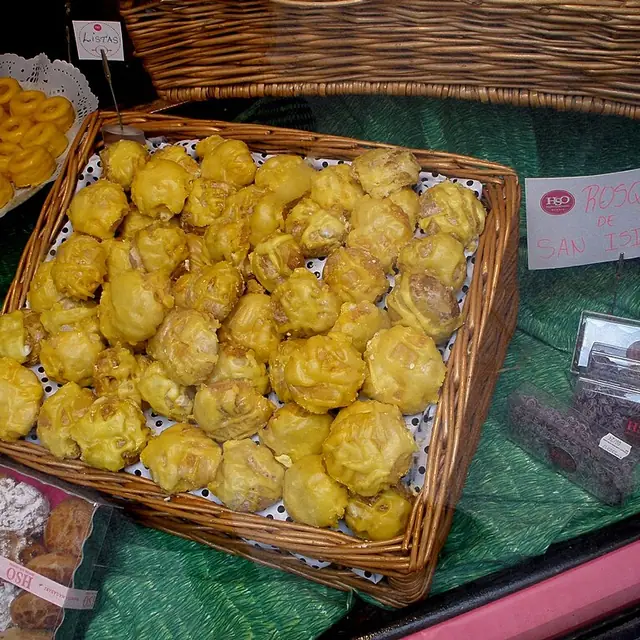
Rosquillas de San Isidro descend from the medieval Castilian rosquilla tradition, with the Madrid version becoming canonical in the 18th century. Four types exist: tontas (matte, aniseed), listas (lemon-glazed), de Santa Clara (white meringue) and francesas (sugar-dusted). The biscuits appear in Madrid bakeries from late April through mid-May, peaking on May 15, the feast of San Isidro Labrador (the city's patron saint). The Pradera de San Isidro picnic on May 15 still draws thousands of locals carrying boxes of rosquillas, tortilla, empanada and a bottle of Valdepenas. La Mallorquina on Puerta del Sol and Horno de San Onofre near Gran Via produce the city's reference rosquillas; boxes sell from 10 to 14 euros.

Common allergens: Gluten, Egg, Dairy

Make it at home

Yield Makes 24 rosquillasHands-on 45 minTotal 2 hrDifficulty Intermediate

Ingredients

  • 500g plain flour
  • 200g caster sugar
  • 2 large eggs
  • 100ml olive oil
  • 100ml dry anisado (anis liqueur)
  • 1 tsp baking powder
  • 1 lemon, zest only
  • 1 tsp aniseed (matalauva)
  • 200g icing sugar, for the glaze
  • 2 tbsp lemon juice, for the glaze

Method

  1. Whisk the sugar and eggs in a bowl until pale and thick, 3 minutes.
  2. Beat in the olive oil, anisado, lemon zest and aniseed.
  3. Sift in the flour and baking powder. Mix to a soft dough. Knead briefly on a floured surface until smooth.
  4. Divide into 24 portions. Roll each into a 15cm rope, then join the ends to form a 4cm ring.
  5. Preheat the oven to 180C. Place the rings on a baking sheet lined with parchment.
  6. Bake 18 to 20 minutes until pale golden. Cool completely on a wire rack.
  7. Mix the icing sugar with the lemon juice and 1 tbsp water to a thick glaze. Dip half the rosquillas in the glaze (these are the listas). The undipped half are tontas.
  8. Let the glaze set 30 minutes before serving.

Tip from the editors. The two-types tradition splits a batch into half-glazed (listas) and half-plain (tontas). Use proper Spanish anisado (Anis del Mono or Chinchon) for the canonical flavour; ouzo is a passable substitute.

This is the TableJourney editorial recipe, modelled on the canonical bistro / counter version. The first place to try the dish in its city of origin is below.

Where to eat rosquillas de san isidro

Rosquillas de San Isidro in Madrid

La Mallorquina ★ 4.5

centroDaily 09:00-21:00Walk-in onlyTraditional Madrid pastries

La Mallorquina on Puerta del Sol in Madrid has sold the napolitana de crema (custard-filled puff pastry) since 1894. The 19th-century counter still queues out the door every morning.

Tip: Walk-in only; the counter fills up by 09:30. Cash strongly preferred at the counter. The upstairs cafe takes seated customers.

Worth the queue: Napolitana de crema

Horno de San Onofre ★ 4.4

centroMon-Sat 09:00-21:00Walk-in onlyMadrileno pastries

Horno de San Onofre in Madrid's Gran Via is the 1972-founded panaderia and pasteleria with the canonical rosquillas de San Isidro (May festival ring biscuits) and a daily-changing fresh-bread counter.

Tip: Closed Sundays. The rosquillas de San Isidro (10 euros per box) appear from late April to early June.

Worth the queue: Rosquillas de San Isidro

Antigua Pasteleria del Pozo ★ 4.5

centroMon-Fri 09:30-14:00 and 17:00-20:30Walk-in onlyMadrileno pastries

Antigua Pasteleria del Pozo in Madrid is the 1830-founded pastry shop with the city's oldest sweet-pastry counter, the pastel ruso, and the wood-and-marble shopfront preserved since the 19th century.

Tip: Closed weekends. Cash preferred. The pastel ruso (3 euros) and the rosquillas tontas y listas are the headlines.

Worth the queue: Pastel ruso

More cities are in research. Want rosquillas de san isidro covered somewhere specific? Tell us where you want to eat.

Browse all dishes →