History

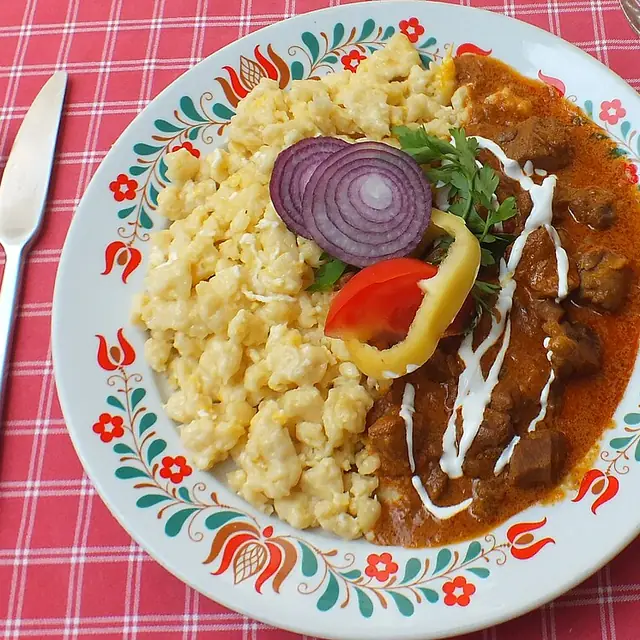
Pörkölt is the thick Hungarian braise that the world often calls goulash. It is older than the paprika version, probably pre-paprika, with the spice added from the 19th century. Eaten with nokedli (egg dumplings), potatoes or rice. The dish is built on a base of slow-cooked onions and lard, with no water beyond what comes from the meat and onions.

Common allergens: Egg (in the nokedli), Gluten (in the nokedli)

Make it at home

Yield 4Hands-on 30 minTotal 2 hr 30 minDifficulty Easy

Ingredients

  • 800g beef chuck or pork shoulder, cubed in 3cm pieces
  • 3 large onions, finely diced (almost the same weight as the meat)
  • 80g lard or pork fat
  • 3 tablespoons sweet Hungarian paprika
  • 1 yellow bell pepper, diced
  • 1 tomato, diced
  • 3 garlic cloves, minced
  • 1 bay leaf, 1 teaspoon caraway seeds
  • Salt and black pepper
  • For nokedli: 300g plain flour, 3 eggs, 100ml water, 1 teaspoon salt

Method

  1. Melt the lard in a heavy casserole. Soften the onions over very low heat for 20 minutes until deep golden and completely broken down. This is the foundation of the dish.
  2. Take the pot off the heat. Stir in the paprika; it must not burn. Add 3 tablespoons water immediately to dissolve the paprika into the onions.
  3. Add the cubed meat, season with salt and pepper, and stir to coat. Return to low heat. Add the bell pepper, tomato, garlic, bay leaf and caraway.
  4. Cover tightly and simmer over the lowest heat for 90 to 120 minutes. The meat releases its juices and the dish self-cooks; check after 60 minutes and add only a splash of water if it threatens to catch.
  5. For the nokedli: whisk flour, eggs, water and salt to a sticky batter. Rest 10 minutes.
  6. Bring a wide pot of salted water to a boil. Push the batter through a nokedli press or holes of a colander directly into the water. Cook 2 minutes after they rise to the surface, drain.
  7. Plate the nokedli, ladle the pörkölt generously on top, finish with a small pickle on the side.

Tip from the editors. The onion-to-meat ratio is almost 1:1 and is the secret of real pörkölt. Onions break down into the sauce; no other liquid is needed.

Where to eat pörkölt

Pörkölt in Budapest

Hungarikum Bisztró ★ 4.5

Traditional Hungarian$$lipotvarosMon-Sun 12:00-14:30, 18:00-22:00

Hungarikum Bisztro on Steindl Imre near Parliament cooks the canonical Hungarian classics, with goulash, chicken paprikash and stuffed cabbage in a tiny.

Signature: Goulash soup, Chicken paprikash

Order: The chicken paprikash with house nokedli and cucumber salad.

Tip: Online reservation only; the small room books out for both lunch and dinner.

Gettó Gulyás ★ 4.4

Traditional Hungarian$$erzsebetvarosMon-Tue 12:00-22:30; Wed 12:00-23:00; Thu-Fri 12:00-23:45

Getto Gulyas on Wesselenyi cooks 14 varieties of Hungarian stews alongside Jewish-Hungarian classics in a tiny ghetto-era room in the Jewish Quarter.

Signature: Beef goulash, Rooster pörkölt

Order: The rooster pörkölt with nokedli; the Jewish egg paste as a starter.

Tip: Tiny room, no walk-ins after 19:00; reserve a day ahead Walk-ins usually OK.

Kőleves Vendéglő ★ 4.2

Modern Hungarian$$erzsebetvarosTue-Wed 12:00-22:00, Thu-Sat 12:00-23:00, Sun 12:00-22:00, Mon closed

Koleves on Kazinczy in an old kosher meat plant cooks affordable Hungarian and Jewish-Hungarian lunch menus, with a hidden summer garden across the road.

Order: The weekday lunch deal of soup, main and dessert.

Why locals love it: An old kosher meat plant turned weekday lunch room with a hidden summer garden across the road.

Tip: Lunch menu Mon to Fri until 16:00; the summer garden across the road is the better seat.

More cities are in research. Want pörkölt covered somewhere specific? Tell us where you want to eat.

Browse all dishes →