

History
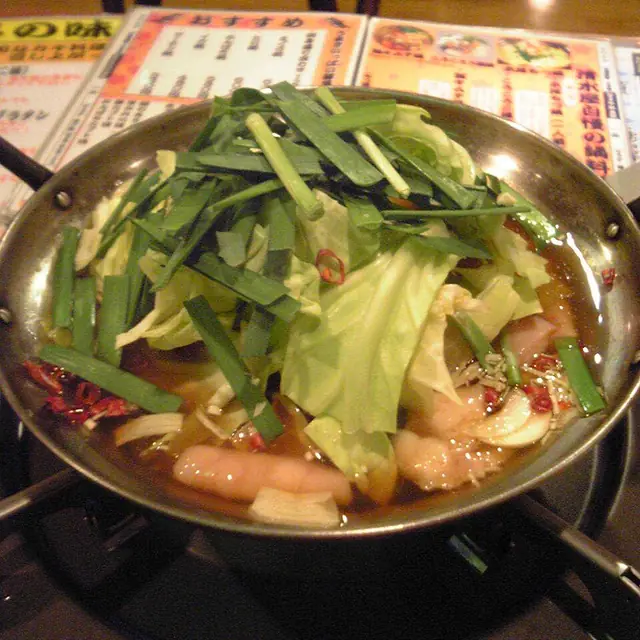
Motsunabe came from Fukuoka's postwar Korean community, who brought the practice of cooking beef offal in a hotpot format. The dish stayed local until Yamanaka opened in Ohashi in 1984 and codified the miso-based version with garlic chives and cabbage; Rakutenchi followed with the soy-sauce style. Through the 1990s motsunabe boomed nationally as a Hakata regional specialty. The champon-noodle finish is a Yamanaka invention. The dish runs from October through March in most rooms; some carry it all year.
Book a food experience
Tours, tastings and classes from the cities on this page, bookable on GetYourGuide.

Common allergens: Soy, Gluten, Egg
Make it at home
Ingredients
- 500g beef offal (small intestine), blanched
- 800g shredded green cabbage
- 1 large bunch garlic chives, cut into 5cm lengths
- 100g bean sprouts
- 200g Korean miso paste OR 100ml shoyu
- 1L dashi stock
- 6 garlic cloves, sliced
- 15g ginger, julienned
- 1 small red chilli, sliced
- 400g champon noodles, for the finish
Method
- Blanch the offal for 10 minutes in boiling water, drain, rinse.
- In a clay pot or shallow heavy casserole, layer cabbage at the base, then offal, then bean sprouts, then a final layer of garlic chives on top.
- Whisk the miso (or shoyu) into the dashi stock with garlic, ginger and chilli. Pour gently over the vegetables to just submerge the cabbage layer.
- Cover and bring to a hard simmer over the table burner or stove. Cook 25 to 30 minutes until the cabbage softens and the offal is tender.
- Serve from the pot at the table. When two-thirds eaten, drop the champon noodles into the remaining broth and cook 3 minutes.
Tip from the editors. The garlic chive layer wilts onto the offal and is the dish's defining seasoning. Do not under-chive.
Where to eat motsunabe
Motsunabe in Fukuoka
Hakata Motsunabe Yamanaka Akasaka ★ 4.6
Yamanaka invented miso-style motsunabe in 1984. The Akasaka branch is the most central of three Fukuoka outlets and the easiest reservation.
OrderMiso motsunabe for two with the champon noodle close.
TipReserve a day ahead for dinner. Closes between 14:30 and 17:00 for the afternoon break.
Motsunabe Rakutenchi Tenjin So-Honten ★ 4.5
Rakutenchi's Tenjin flagship: three floors and 240 horigotatsu seats, the largest motsunabe room in Kyushu. Soy-sauce base, mountain of garlic chives.
OrderPuripuri motsu daimanzoku course with all-you-can-eat champon noodles.
TipOpen daily 17:00-24:00. Reserve through the operator's site or by phone.
Hakata Motsunabe Yamanaka Hakata ★ 4.4
Hakata Station branch of Yamanaka's miso-motsunabe original, closer to the shinkansen than the Akasaka room, with the same recipe since 1984. Most central.
OrderMiso motsunabe for two, finished with champon noodles.
TipReserve ahead for dinner; the room fills with business travellers most weeknights.
Hakata Motsunabe Yamanaka Ohashi Honten ★ 4.2
The original 1984 Yamanaka, a warehouse building in Ohashi where miso motsunabe was first codified. Hardest to reach of the three Yamanaka rooms; quietest.
Book1 to 2 weeks ahead
TipReserve through the operator's site. Bring a small group; the room is built for parties of four.
More cities are in research. Want motsunabe covered somewhere specific? Tell us where you want to eat.