History

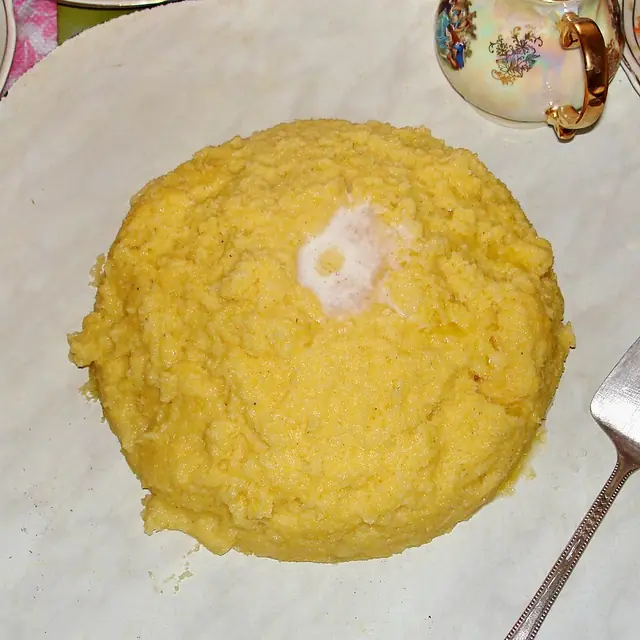
Mămăligă entered Romanian cooking when maize arrived from the Americas via Ottoman trade routes in the 17th century, displacing earlier millet porridge. Through the 18th and 19th centuries it became the peasant staple and the rural breakfast, named the national bread by the writers of the 1848 generation. The modern Bucharest restaurant version uses fine cornmeal cooked stiff, sliced with a thread, and served as a side or a centrepiece under cheese and sour cream.

Common allergens: Corn

Make it at home

Yield 4Hands-on 15 minTotal 25 minDifficulty Easy

Ingredients

  • 200g coarse cornmeal (porumb, mălai)
  • 800ml water
  • 1 teaspoon fine sea salt
  • 30g butter
  • 200g brânză de oi (sheep cheese) or fresh ricotta
  • 100g smântână (sour cream)
  • Optional: 4 fried eggs and slănină (cured pork fat) slices

Method

  1. Bring the salted water to a rolling boil in a heavy-bottomed pot.
  2. Reduce heat to medium, then rain the cornmeal in through your fingers while whisking constantly to prevent lumps.
  3. Switch to a wooden spoon and stir continuously for 10-12 minutes until the cornmeal pulls away from the sides of the pot.
  4. Stir in the butter and a pinch more salt; turn out onto a wooden board.
  5. Slice with a wet kitchen knife or a piece of strong thread.
  6. Top each slice with crumbled brânză, a spoonful of smântână, and a fried egg if you want the full version.
  7. Serve immediately while still hot, the cheese melting into the surface.

Tip from the editors. Coarse cornmeal beats fine: it holds shape when cooled. The wooden-spoon stirring matters; metal spoons drag heat away and make the polenta gluey.

Where to eat mămăligă

Mămăligă in Bucharest

Vatra ★ 4.3

Romanian$$cismigiuMon-Sun 12:00-23:30

Vatra on Brezoianu cooks traditional Romanian on bakestones and in tin kettles, in a 1920s Transylvanian interior next to Cișmigiu Park in Bucharest.

Signature: Sarmale, Tochitură, Romanian cheese plate

Order: Sarmale with mămăligă; the cheese plate of Brașov sheep and Sibiu cow.

Tip: The veranda opens May through October; lunch fixed menu is 45 RON.

Lacrimi și Sfinți ★ 4.5

Modern Romanian$$$lipscaniMon-Sun 12:00-24:00

Poet Mircea Dinescu's Lacrimi și Sfinți on Șepcari pours wines from his Cetate estate alongside modern Romanian classics in Bucharest Old Town today.

Signature: Sarmale, Mămăligă cu brânză, Slănină plate

Order: The signature sarmale; a glass of Cetate Riesling Italian.

Tip: The wine list is heavy on Dinescu's own bottlings; ask the room for the day's house pour.

Caru' cu bere ★ 4.6

Traditional Romanian$$$lipscaniMon-Sun 10:00-24:00

The 1879 Caru' cu bere on Stavropoleos serves the soul of Bucharest dining, where mici were recorded in a 1920 chef's letter to the Academy.

Signature: Mici, Sarmale, Papanași

Order: Mici with mustard and ciorbă de burtă, then papanași for dessert.

Tip: Walk-up queues from 12:30 onward; the upstairs hall has the live folk band.

Hanu' lui Manuc ★ 4.4

Traditional Romanian$$$lipscaniMon-Thu 10:00-24:00; Fri-Sat 10:00-02:00; Sun 10:00-24:00

The 1808 caravanserai-turned-restaurant Hanu' lui Manuc on Franceză serves classic Romanian plates around one of Europe's last remaining inn courtyards.

Signature: Mici, Sarmale, Lamb tochitură

Order: Mici and a lamb tochitură; the cabbage rolls feed two.

Tip: The courtyard fills first; ask for a balcony table inside the U-shaped inn.

Crama Domnească ★ 4.1

Traditional Romanian$$lipscaniTue-Sun 12:00-24:00; Mon 14:00-24:00

Crama Domnească sits in the cellar of the Princely Court on Șelari, the Princely Wine Cellar in Bucharest, with live folk and house wines by carafe.

Signature: Sarmale, Mămăligă, Ciorbă de burtă

Order: Mămăligă with brânză and smântână; a clay-pot tochitură.

Tip: Live taraf music every evening; cash and card both accepted.

More cities are in research. Want mămăligă covered somewhere specific? Tell us where you want to eat.

Browse all dishes →