

History
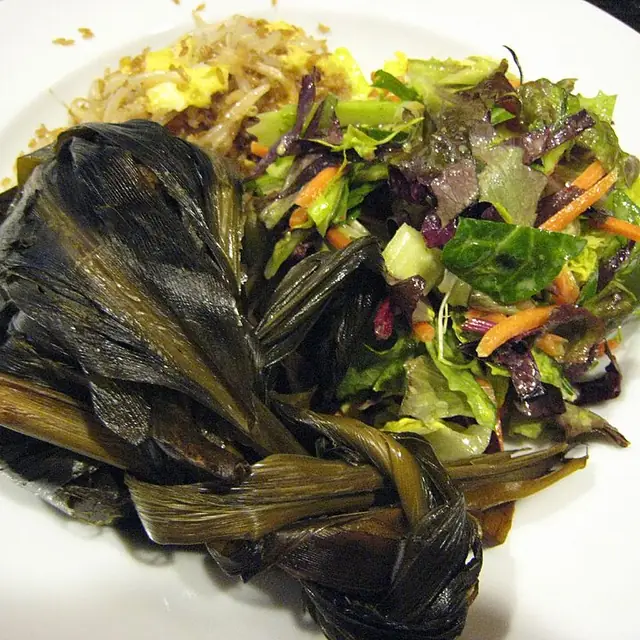
Laulau is pre-contact Hawaiian. The traditional dish wrapped pork, salt, and sometimes butterfish in luau (kalo) leaves, then in ti leaves, and steamed it in the imu underground oven alongside the kalua pig. The luau leaves cook into a spinach-like wrap and the wrap absorbs the smoke. Highway Inn Kakaako and Helena's Hawaiian Food both run canonical laulau plates with butterfish and pork. Modern home cooks steam them in a stove-top pot rather than the imu; the result is similar though missing the smoke notes.
Book a food experience
Tours, tastings and classes from the cities on this page, bookable on GetYourGuide.


Common allergens: Fish
Make it at home
Ingredients
- 600g boneless pork shoulder, cut into 4 equal portions
- 200g butterfish (or substitute with black cod), cut into 4 pieces
- 16 large luau (taro) leaves, washed (or substitute with collard greens)
- 8 large ti leaves (or substitute with banana leaves)
- 2 tablespoons Hawaiian alaea sea salt
- 240ml water
Method
- Trim the central stem of each luau leaf with a paring knife. The stem holds calcium oxalate that irritates the throat raw; you must steam-cook it.
- Salt the pork portions on all sides. Place one piece of pork and one piece of butterfish on a pile of 4 luau leaves.
- Wrap the luau leaves around the meat into a tight parcel. Then wrap two ti leaves around the parcel and tie with a knot at the top, or with kitchen string.
- Stand the four parcels upright in a deep steamer or a heavy pot fitted with a steaming rack. Pour 240ml water into the bottom.
- Cover and steam at a low boil for 4 hours. The leaves should be dark green and the meat fall-apart tender; check water level halfway and top up.
- Lift each parcel onto a plate. Untie the ti leaves at the table; eat the steamed luau leaves with the meat like a wrap. Serve with rice and lomi salmon.
Tip from the editors. Do not eat raw luau or taro leaves under any circumstances; the calcium oxalate crystals burn the throat. You must cook at least 60 minutes. Frozen taro leaves from a Hawaiian or Filipino grocery work if fresh is unavailable.
Where to eat laulau
Laulau in Honolulu
Helena's Hawaiian Food ★ 4.8
Helena's Hawaiian Food is locals queue for this 1946 kalihi institution but most visitors never venture past chinatown to north school street.
Why locals goLocals queue for this 1946 Kalihi institution but most visitors never venture past Chinatown to North School Street.
TipTuesday to Friday 10:00-19:30. Pipikaula short ribs are the must-order; the kalua pig is also canonical.
Highway Inn Kakaako ★ 4.3
Highway Inn Kakaako Honolulu serves a combination kalua pig plate with rice, mac salad and lomi salmon for around $15, the cheapest sit-down Hawaiian food.
TryKalua pig combo plate
TipDaily 09:30-20:00. Mini plate at $13 feeds one; combo plate at $18 feeds two with leftovers.
More places near Helena's Hawaiian Food and Highway Inn Kakaako
Not on this list, but close by, nearest first. Every one is in our guide with its address, hours and what to order.
- Maguro Brothers Hawaii Chinatown Poke, about 200 m away
- Chinatown Honolulu Marketplaces Market, about 200 m away
- Lucky Belly Ramen, about 300 m away
- Senia Modern Hawaiian, about 300 m away
- The Manifest Cafe, about 350 m away
- Bar 35 Pizzeria, about 350 m away
More cities are in research. Want laulau covered somewhere specific? Tell us where you want to eat.