History

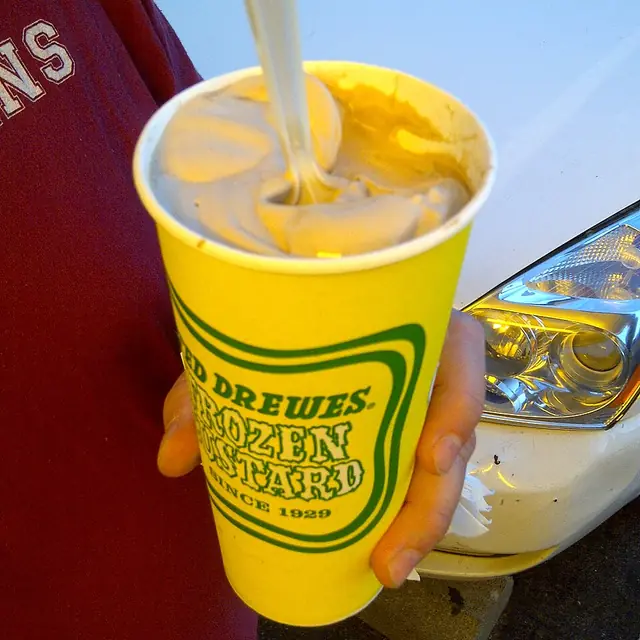
Frozen custard, an egg-enriched ice cream, took hold in the Midwest in the 1930s, and Ted Drewes opened his Chippewa Street stand on Route 66 in 1941. The concrete, blended so stiff it can be handed over upside down without spilling, became the signature, a showmanship move that doubles as proof of thickness. The Chippewa stand still draws summer lines and ranks among the most enduring food landmarks in the city.

Common allergens: Egg, Dairy

Make it at home

Yield Serves 2Hands-on 10 minTotal 10 minDifficulty Easy

Ingredients

  • 4 large scoops good vanilla frozen custard or premium vanilla ice cream
  • Mix-ins of choice: crushed cookies, fruit, chocolate, nuts
  • A splash of whole milk if needed

Method

  1. Soften the custard for a few minutes so it blends but stays very thick.
  2. Add the custard and your mix-ins to a blender or stand mixer.
  3. Blend on low just until combined, scraping down, keeping it as stiff as possible.
  4. If it is too thick to blend, add only a small splash of milk.
  5. Spoon into a cup and, to test it the St. Louis way, turn it upside down; a true concrete will not fall out.

Tip from the editors. Keep it as stiff as the machine allows; the upside-down test is the whole point of a concrete.

This is the TableJourney editorial recipe, modelled on the canonical bistro / counter version. The first place to try the dish in its city of origin is below.

Where to eat frozen custard concrete

Frozen custard concrete in St. Louis

Ted Drewes Frozen Custard ★ 4.6

st-louis-hills

Serving since 1941 on Route 66, Ted Drewes sells cheap, thick frozen-custard concretes, the landmark dessert handed over upside down to prove it.

Try: Frozen custard concretes

Tip: A concrete is a few dollars and a city rite of passage. Cash-friendly; expect a summer line at the window.

More cities are in research. Want frozen custard concrete covered somewhere specific? Tell us where you want to eat.

Browse all dishes →