History

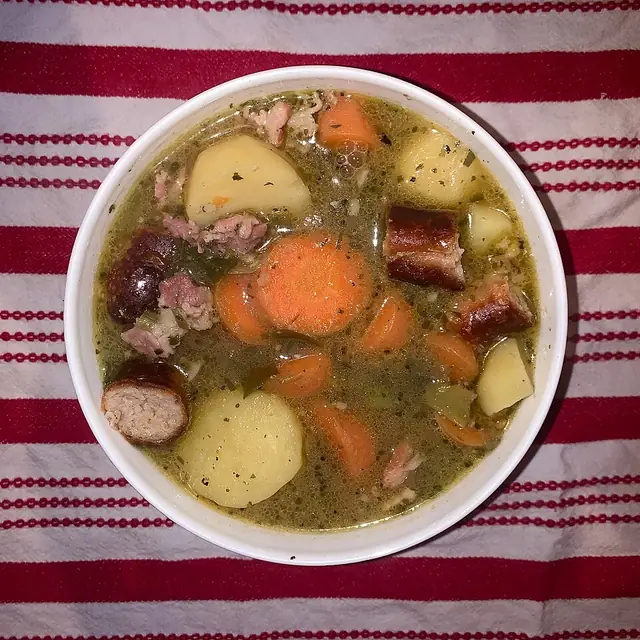
Coddle emerged in the eighteenth-century Liberties tenements as a one-pot way to use up the week's leftover sausages and bacon rashers before they spoiled. The recipe held no roasted vegetables and was famously deglazed only with cooking water, never browned. Jonathan Swift and James Joyce both wrote about coddle; Joyce's Leopold Bloom passes a coddle pot in Ulysses. The dish is the working-class Dublin signature, served still at Spitalfields on The Coombe, The Brazen Head and Gallagher's Boxty House. The pale, broth-soaked colour is the dish's tell; properly cooked, the sausages should split.

Common allergens: Gluten, Sulphites

Make it at home

Yield Serves 4Hands-on 20 minTotal 2 hrDifficulty Easy

Ingredients

  • 8 good-quality pork sausages
  • 8 thick rashers of streaky bacon, cut into 4cm pieces
  • 1kg floury potatoes (Maris Piper), peeled and cut into chunks
  • 2 large onions, sliced
  • 500ml chicken or pork stock
  • 1 bay leaf
  • Small handful flat-leaf parsley, chopped
  • Sea salt and black pepper
  • Crusty soda bread to serve

Method

  1. Blanch the sausages in boiling water for 3 minutes to remove excess fat. Drain, set aside.
  2. Heat a heavy lidded pot over medium heat. Add the bacon and cook for 5 minutes until the fat renders. Do not brown; you want it pale.
  3. Add the onions to the pot and sweat for 8 minutes until translucent.
  4. Layer the potatoes over the onions and bacon, then nestle the sausages on top.
  5. Pour over the stock to barely cover, drop in the bay leaf and season lightly.
  6. Cover and simmer gently for 90 minutes, until the potatoes are tender and the sausages have soaked the broth.
  7. Scatter the parsley over the top. Serve straight from the pot with crusty soda bread for mopping.

Tip from the editors. Do not let the pot boil hard; the sausages should never brown. The pale broth is the point and the soda bread is for the gravy.

This is the TableJourney editorial recipe, modelled on the canonical bistro / counter version. The first place to try the dish in its city of origin is below.

Where to eat dublin coddle

Dublin coddle in Dublin

Spitalfields ★ 4.5

Modern Irish€€the-liberties

Spitalfields on The Coombe in Dublin's Liberties, a Michelin Bib Gourmand pub-set kitchen serving the city's most considered classical Irish menu.

Signature: Tom Crean's oyster stew, Slow-cooked beef cheek, Dublin coddle

Order: The seasonal stew with soda bread, and the coddle when it lands on the daily card.

Tip: Tuesday to Saturday dinner only, 17:00 to 21:00. Walk through the public bar and ask for the back dining room.

The Brazen Head ★ 4.4

Traditional pubthe-liberties

The Brazen Head on Bridge Street Lower in Dublin 8, established 1198 as Ireland's oldest pub, the present 1754 coaching inn serves Irish stew and trad sessions nightly.

Signature drink: Guinness with an Irish stew

Food: Full Irish pub kitchen, food to 21:00

Tip: Food served until 21:00 daily; nightly trad music sessions from 21:00. The back snug holds eight; the courtyard runs summer only.

Gallagher's Boxty House ★ 4.2

Irish€€temple-bar

Gallagher's Boxty House on Temple Bar in Dublin, Pádraic Óg Gallagher's three-room canon of boxty, coddle and smoked salmon, the boxty reference in town.

Signature: Boxty pancake, Dublin coddle, Smoked Irish salmon

Order: The boxty pancake stuffed with beef and Guinness, with a half pint of stout.

Tip: The middle dining room is the calm one; the front bar fills with traffic from Temple Bar Square after 19:00.

The Stag's Head ★ 4.5

Traditional pubsouth-city-centre

The Stag's Head on Dame Court in Dublin 2, a Victorian pub since 1860 with original mahogany and a stained-glass roof, the city's archetypal Dublin pub interior.

Signature drink: Guinness with an Irish stew

Food: Irish pub menu, full kitchen

Tip: Two bars; the downstairs is the trad pub, the upstairs Parliament Hotel is the late bar. Irish stew at lunch is the value play.

More cities are in research. Want dublin coddle covered somewhere specific? Tell us where you want to eat.

Browse all dishes →