
History

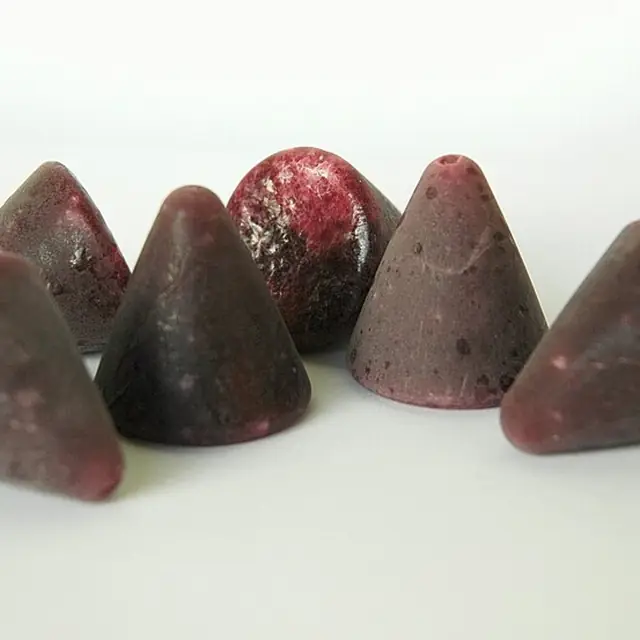
Cuberdons were invented in the 1870s in Ghent, when pharmacist De Vynck stumbled across the formula while trying to keep cough syrup from crystallising too quickly. The cone shape and the curious liquid-jelly interior became the structural identifier; the canonical raspberry version emerged immediately and remains the most popular. The Antwerp cuberdon street culture grew through the 20th century and culminated in the bitter Ghent rivalry between two main makers (the 'cuberdon war' of the early 2010s). Antwerp's Christmas markets sell them by the small white bag. The interior must remain liquid; once a cuberdon dries out, it is no longer technically a cuberdon.

Make it at home

Yield 30Hands-on 1 hr 30 minTotal 72 hrDifficulty Advanced

Ingredients

  • For the sugar syrup that forms the hard outer cone: 500g granulated sugar
  • 250ml water
  • 50g powdered glucose
  • For the raspberry filling: 200g good raspberry jam (passed through a fine sieve to remove seeds)
  • 100g granulated sugar
  • 50ml water
  • 1 tsp pectin powder OR 2 tsp gum arabic powder (the canonical historical thickener; food-grade gum arabic is sold by specialty baking suppliers)
  • 1 tbsp lemon juice
  • Red food colouring (optional, for stronger colour)
  • 1 tsp raspberry flavouring or 2 tbsp framboise liqueur
  • Special equipment: cuberdon moulds (silicone cone-shaped moulds, 4cm tall by 3cm wide; or cone-shaped chocolate moulds; or homemade by piping aluminium foil cones onto a tray)

Method

  1. Make the raspberry filling first: combine the sieved raspberry jam, sugar, water, pectin or gum arabic, lemon juice and raspberry flavouring in a small saucepan.
  2. Bring to a gentle simmer over medium-low heat, whisking constantly to dissolve the pectin/gum, and cook for 5 to 8 minutes until thickened to the consistency of warm honey.
  3. Cool slightly while you prepare the sugar shell.
  4. Make the hard sugar shell: combine the sugar, water and glucose in a heavy saucepan; brush down any sugar crystals from the sides with a wet pastry brush.
  5. Bring to a boil and cook to 145 degrees Celsius (hard-crack stage) on a candy thermometer; do not stir, just swirl the pan occasionally.
  6. Immediately remove from heat, let bubbles subside for 30 seconds.
  7. Pour the hot syrup carefully into the cuberdon moulds, filling about three-quarters. Working quickly (the syrup hardens fast), invert each mould over an empty tray to pour out the centre, leaving only a thin coating clinging to the walls of each cone.
  8. Allow to set 15 minutes; the cones will be thin-walled and hollow.
  9. Pipe the warm raspberry filling into each hollow cone using a small piping bag fitted with a fine nozzle, filling to within 3mm of the top.
  10. Use a small dab of fresh hot sugar syrup to seal the bottom (now the wide opening) of each cone.
  11. Place the filled cuberdons (point-up) on a tray and let stand at room temperature for 72 hours to allow the gum arabic or pectin to slowly hydrate and develop the characteristic semi-liquid jelly interior.
  12. Store in an airtight container at room temperature; eat within 2 to 3 weeks before they crystallise.

Tip from the editors. The cuberdon is famously difficult to reproduce at home; the 3-day rest is the structural step that develops the liquid-jelly interior. Gum arabic gives the most authentic texture but is hard to find; pectin works but the interior firms faster. Buy them from a Belgian sweet shop instead and skip the recipe headache.

Where to eat cuberdons (neuzekes)

Cuberdons (Neuzekes) in Antwerp

Bakkerij Goossens ★ 4.6

BakerytheaterbuurtTue-Sat 07:00-19:00, closed Sun-MonWalk-in onlyRaisin bread (roggeverdommeke) and brioches

Bakkerij Goossens in Antwerp has worked the same Renaissance house with stepped gable since 1884. The roggeverdommeke rye-raisin loaf is the canonical bake.

Tip: Lines start before 09:00 on Saturday. Arrive early for first pick of the brioches.

Worth the queue: Roggeverdommeke rye-raisin bread

Kleinblatt ★ 4.3

BakerydiamantwijkSun-Thu 06:00-19:00, closed SaturdayWalk-in onlyKosher Belgian bakery

Kleinblatt in Antwerp is the city's largest kosher bakery, in the diamond district on Provinciestraat. Open sun-thu 06:00-19:00, closed saturday.

Tip: Closed Saturday for Shabbat. Friday afternoon is the busiest sitting for pre-Shabbat challah pickup.

Worth the queue: Sesame seed bread, bagels, challah

Bakker Aldo ★ 4.3

Bakeryberchem

Bakker Aldo in Antwerp bakes slow-fermented sourdough on Lange Leemstraat. The lunch counter sandwich is under 10 euro and built on the day's bake.

Try: Sourdough sandwich

Tip: Closed Monday and Tuesday. The Geefstraat city-centre branch keeps the same lunch lineup.

More cities are in research. Want cuberdons (neuzekes) covered somewhere specific? Tell us where you want to eat.

Browse all dishes →