Surinamese cuisine is one of the most genuinely multicultural kitchens in the world, the product of a small South American country whose population is descended from indigenous Amerindians, enslaved West Africans, indentured Javanese Indonesians, indentured Indians (Hindustani), Chinese contract laborers, Dutch colonists, and Sephardic Jews. The cuisine reflects all of these traditions in a single national table, and a typical Surinamese family meal might include Javanese bami, Indian roti, Chinese-style chow mein, and West African-descended pom, with pickles and chile sauces drawn from each tradition.
The everyday signature is roti: the Surinamese version is a large, soft, flaky layered flatbread (paratha-derived from the Hindustani tradition) served wrapped around a curry of chicken, potato, and long beans (kouseband). It is the country's most ubiquitous lunch and a Saturday dinner standard in Surinamese diaspora homes across the Netherlands. Equally fundamental are pom (the Creole baked oven dish of grated pomtajer root, chicken, and citrus), saoto (the Javanese-Surinamese chicken soup with rice, bean sprouts, and crispy potato), bami goreng (Javanese fried noodles), nasi goreng, and a parade of sambals.
The Netherlands is where Surinamese cuisine is most visible outside the country, particularly in Amsterdam, Rotterdam, and The Hague, where Surinamese-Hindustani and Surinamese-Javanese 'toko' (shop-restaurants) are everyday lunch institutions. A 'broodje pom' or a 'roti kip' is part of the Dutch-Surinamese vocabulary that the broader Dutch culture has now adopted. The cuisine's distinctive eating logic, multiple traditions on one plate as a default rather than a special occasion, mirrors the country's national motto of unity in diversity (Justitia Pietas Fides), and the food remains one of the most direct expressions of Surinamese identity both at home and across the diaspora.
Book a food experience
Tours, tastings and classes that match this page, bookable on GetYourGuide.
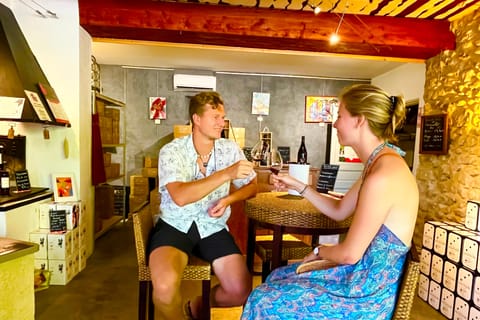
The Wine Tour is an amazing and real experience not to be missed in the surrounding area of Cagliari. Enjoy the beautiful scenery while tasting some...
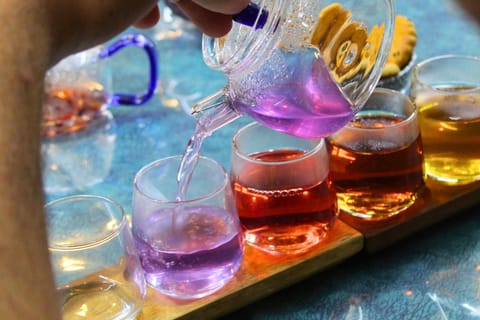
Discover world teas and traditional Turkish tea culture in a cozy workshop. Learn brewing techniques, taste different teas, and experience the social...
A Surinamese lunchroom since 1982 that locals consider the most authentic pom, roti, and saoto in the city. Located in Centrum. At Witte de Withstraat 47.
Why locals goNo English signage, cash only, and easily missed on the busy Pannekoekstraat strip
A Surinamese lunchroom since 1982 that locals consider the most authentic pom, roti, and saoto in the city. Located in Centrum. At Witte de Withstraat 47.
Why locals goNo English signage, cash only, and easily missed on the busy Pannekoekstraat strip
The birthplace of kapsalon, invented here in 2003: shoarma on frites, Gouda baked over the top, finished with garlic sauce and salad. Located in Delfshaven.
TipThis is the original kapsalon address from 2003. Ask for extra Gouda on top.
Warung Spang Makandra has been the De Pijp Surinamese reference since 1978: roti you assemble yourself, saoto soup, almost nothing on the menu over 15 euros.
OrderRoti kip with the dahl and a side of the bean stew.
TipWalk-in only. Order at the counter, sit upstairs. A second Spang Makandra branch in Nieuw West takes the overflow.
The Surinamese flaky layered flatbread (descended from Indian paratha), folded around a curry of chicken on the bone, potato, kouseband (long bean), and boiled egg, with hot Madame Jeanette chile sauce on the side. Eaten by hand. The country's most famous dish.
Pom
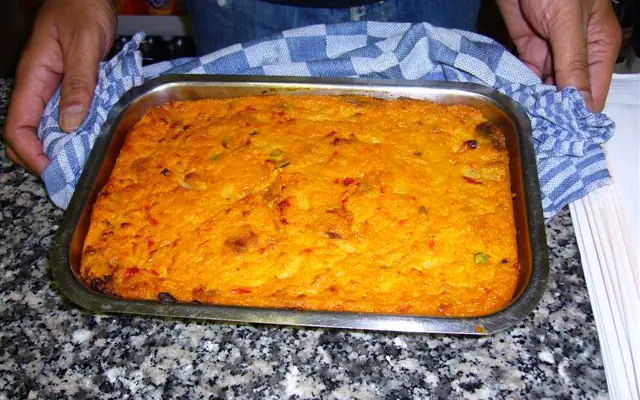
Baked oven dish of grated pomtajer (the local malanga root), chicken, salted meat, onion, tomato, and citrus, baked until golden on top and creamy underneath. Creole-Jewish origin; the Saturday-dinner Creole staple.
Saoto
Javanese-Surinamese chicken soup with clear turmeric broth, served over rice with bean sprouts, fried potato sticks, hard-boiled egg, fried shallots, sambal, and celery. Built at the table by the eater.
Bami goreng
Javanese-Surinamese fried noodles with chicken, shrimp, cabbage, kecap manis, and a fried egg on top. The everyday Surinamese-Javanese lunch.
Nasi goreng
Fried rice with chicken, shrimp, kecap manis, sambal, and a fried egg. The Indonesian-Surinamese counterpoint to bami.
Moksi meti
Mixed roasted meats (chicken, pork, sometimes Chinese roast pork) over rice with pickled vegetables. Creole-Chinese fusion.
Bara
Hindustani-Surinamese fried lentil-and-yellow-split-pea fritter, eaten as a snack with tamarind chutney or chile sauce.
Telo
Fried cassava sticks served with bakkeljauw (salted cod) and Madame Jeanette chile sauce. Creole street food.
Pastei
Dutch-Creole chicken-and-vegetable pot pie with raisins and citrus. The Creole celebration centerpiece.
Madame Jeanette
The yellow scotch-bonnet-cousin chile that is the heat of Surinamese cooking. Used in nearly every sambal and side sauce; can be hotter than a habanero.
Pinda soep
Peanut soup with chicken and salted meat, descended from the West African mafe tradition via the enslaved population. Thick, rich, often served with rice or tom-tom (plantain dumpling).
Pastei
Dutch-Creole chicken pot pie.
How to order
At a Surinamese toko (a casual lunch counter), the order is straightforward: roti chicken (roti kip), roti vegetarian (roti groente), bami, nasi, saoto soup, or pom. Each comes with sambal and pickled vegetables. At a sit-down Surinamese restaurant, the table might share a roti, a saoto, and a moksi meti, with bara as a starter. Pom is usually only on the menu on weekends or at celebrations. Madame Jeanette sauce is poured by the spoon: start small.
The rookie mistakes: dousing the food in Madame Jeanette without tasting first (it is hotter than expected), trying to eat roti with a knife and fork (it is finger food), ordering one dish per person without sharing (the cuisine is built on sampling across traditions in one meal), and assuming the Javanese dishes (bami, nasi, saoto) are interchangeable with Indonesian-Indonesian versions (the Surinamese versions have evolved into their own thing over 150 years).
What to drink with it
Parbo (the Surinamese national beer) is the universal pairing. Borgoe rum, distilled from Surinamese sugar cane, is the national spirit, often served straight or as a rum-cola. Dawet (a Javanese green-rice-flour-noodle iced drink with coconut milk and palm sugar) and markisa (passionfruit juice) are the non-alcoholic options. With roti, beer or a tamarind drink works; with saoto, the soup is the drink. Bitterballen and other Dutch bar snacks have crossed into the Surinamese bar scene in Paramaribo and Amsterdam.
Where to eat it
Paramaribo is the only major Surinamese-food city in the country, with the country's full national-fusion table in markets like Centrale Markt and casual toko restaurants throughout the capital. The Netherlands, particularly Amsterdam (Bijlmer especially), Rotterdam, and The Hague, holds the largest and most accessible Surinamese restaurant scene outside Suriname, with hundreds of toko's and broodjeszaak counters. Surinamese roti is now one of the de facto Dutch national foods alongside frites and bitterballen.
A short history
Surinamese cuisine emerged from the meeting of indigenous Arawak and Carib peoples, Dutch colonization (1667), the enslavement of West Africans on sugar plantations (which produced the Creole tradition and gave Suriname pom, peanut soup, and cassava cooking), the post-abolition indenture of Hindustani Indians (1873) and Javanese Indonesians (1890), and Chinese contract migration. The country gained independence from the Netherlands in 1975, and Surinamese cuisine has traveled with the diaspora into the Dutch mainstream over the past 50 years.
Frequently asked
Is Surinamese food the same as Indonesian?
Overlap on the Javanese-descended dishes (bami, nasi, saoto) but distinct overall. Surinamese-Javanese cooking has evolved separately from Indonesian-Javanese for over a century, and the broader Surinamese national cuisine fuses Javanese with Hindustani, Creole, Chinese, and Dutch traditions in ways that Indonesia does not.
Where can I try Surinamese food outside Suriname?
The Netherlands. Amsterdam, Rotterdam, and The Hague have the largest Surinamese diaspora in the world and the best restaurant access. Smaller scenes exist in Brussels, Paris (Guianese-French overlap), and increasingly Miami.
Is Surinamese food spicy?
It can be, via the Madame Jeanette chile sauce that comes on the side. The base cooking is moderately spiced rather than hot; the heat is added at the table by the eater.