

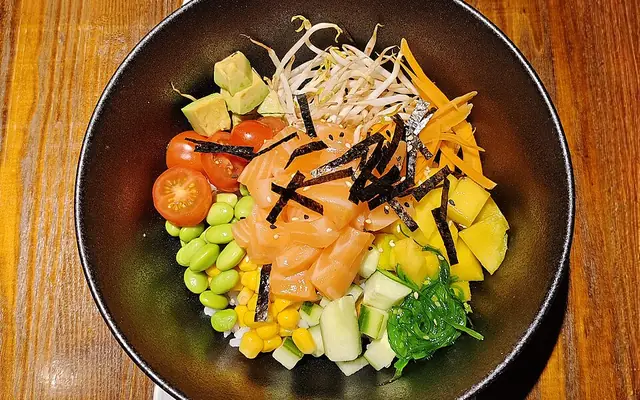
Poke (pronounced poh-keh, two syllables) is the Hawaiian raw-fish dish that exploded into a global health-food trend in the late 2010s, but the original form is a centuries-old Native Hawaiian preparation: small chunks of fresh-caught reef fish (often ahi tuna, but historically also octopus, akule, opihi limpet), mixed with sea salt, limu (Hawaiian seaweed), and inamona (roasted candlenut). The word poke itself means 'to slice or cut' in Hawaiian, referring to the cubed format. The dish was eaten by fishermen at the boat, as a snack, as a side, as a quick lunch.
The modern poke that became globally famous, the soy-sauce-and-sesame-oil-marinated ahi tuna in a rice bowl, is an evolution that took shape in Hawaii in the 1970s and 1980s as Japanese-Hawaiian fusion. Adding shoyu, sesame oil, green onion, and sometimes Korean gochujang to the indigenous poke produced a more pronounced umami flavor and made the dish more accessible to non-Hawaiian palates. By the early 2010s, Honolulu was full of poke shops (Ono Seafood, Maguro Brothers, Foodland) selling pre-marinated poke by the pound, and the chain Sweetgreen and the Chipotle-style poke bowl format took the cuisine globally.
The modern poke bowl, a base of sushi rice with one or two scoops of poke, topped with avocado, edamame, cucumber, pickled ginger, sesame seeds, and seaweed salad, is essentially the bowl version of a deconstructed maki roll. It has become so prevalent that it now exists in dozens of countries, including Australia, the UK, France, Brazil, and Japan (where it has been reimported, in an odd cultural loop). The original Hawaiian poke, served in cups or styrofoam, with no rice and minimal toppings, is still the better dish, but the global poke bowl is what most non-Hawaiian eaters know.
Book a food experience
Tours, tastings and classes from the cities on this page, bookable on GetYourGuide.


Top picks
The best-scored Poke place in each of 4 cities.
Maguro Brothers Hawaii Chinatown ★ 4.7
Maguro Brothers Hawaii Chinatown is a two-brother poke counter inside Kekaulike Market; the Tsuchiya brothers source from the Honolulu Fish Auction at dawn.
Why locals goThe two-brother poke counter inside Kekaulike Market sells out by 13:00 and never opens past lunch, so Waikiki visitors miss it.
TipMonday to Saturday 09:00-14:00. The Tsuchiya brothers source from the Honolulu Fish Auction at dawn.
Sweetfin ★ 3.9
Sweetfin builds chef-driven poke bowls on Broadway in Santa Monica, an entirely gluten-free kitchen of bamboo rice, kale noodles and citrus ponzu fish.
OrderSpicy tuna bowl on bamboo rice
TipEvery bowl base swaps free, so try the kale noodle base; the whole menu is gluten-free by default.
Loki Poke ★ 3.8
Loki Poke builds award-noted poke bowls in a Wapping Wharf container, Bristol's harbourside counter for sushi rice, pickles, poke and house-made sauces.
TryPoke bowls on sushi rice
TipGo half-and-half on the house sauces; the container seats a handful, so take the bowl to the harbour edge.
dubble ★ 3.7
Beside the Machines de l'Île, dubble builds grain and pulse salad bowls, hot bowls and poke from €10, with house juices and weekday breakfast.
SignatureSalad bowls, Hot bowls, Poke bowls
TipOrdering ahead on the operator's site skips the midday queue, which builds fast with the island's office crowd.
Find a place
Maguro Brothers Hawaii Chinatown ★ 4.7
Maguro Brothers Hawaii Chinatown is a two-brother poke counter inside Kekaulike Market; the Tsuchiya brothers source from the Honolulu Fish Auction at dawn.
Why locals goThe two-brother poke counter inside Kekaulike Market sells out by 13:00 and never opens past lunch, so Waikiki visitors miss it.
TipMonday to Saturday 09:00-14:00. The Tsuchiya brothers source from the Honolulu Fish Auction at dawn.
Ono Seafood ★ 4.5
Ono Seafood in Kapahulu Honolulu is the family-run poke counter that fishes shoyu ahi, spicy ahi and tako preparations from the refrigerated case.
OrderA two-scoop shoyu ahi and spicy ahi bowl with rice.
TipClosed Sundays and Mondays, 09:00-18:00 otherwise. No inside seating; eat at the picnic table or take it to Ala Wai Park.
Off the Hook Poke Market ★ 4.5
Off the Hook Poke Market in Manoa Honolulu is the takeout-only poke counter at the foot of Manoa Valley that draws University of Hawaii students.
OrderSpicy ahi and limu ahi over rice, plus a side of furikake.
TipLunchtime queue can run 30 minutes. Closed Sunday; order pickup via the website to skip the line.
Sweetfin ★ 3.9
Sweetfin builds chef-driven poke bowls on Broadway in Santa Monica, an entirely gluten-free kitchen of bamboo rice, kale noodles and citrus ponzu fish.
OrderSpicy tuna bowl on bamboo rice
TipEvery bowl base swaps free, so try the kale noodle base; the whole menu is gluten-free by default.
Loki Poke ★ 3.8
Loki Poke builds award-noted poke bowls in a Wapping Wharf container, Bristol's harbourside counter for sushi rice, pickles, poke and house-made sauces.
TryPoke bowls on sushi rice
TipGo half-and-half on the house sauces; the container seats a handful, so take the bowl to the harbour edge.
dubble ★ 3.7
Beside the Machines de l'Île, dubble builds grain and pulse salad bowls, hot bowls and poke from €10, with house juices and weekday breakfast.
SignatureSalad bowls, Hot bowls, Poke bowls
TipOrdering ahead on the operator's site skips the midday queue, which builds fast with the island's office crowd.
Poke by city





Regional variations
Hawaiian (original)
The indigenous form: cubed raw fish (ahi tuna or octopus), sea salt, limu (Hawaiian seaweed, especially limu kohu), inamona (roasted ground candlenut). Sold by the pound at Foodland and at neighborhood poke shops. Eaten as a snack, with rice on the side or alone.
Hawaiian-Japanese fusion (shoyu poke)
The 1970s and 1980s evolution: soy sauce, sesame oil, green onion, sometimes mirin and rice vinegar, ginger. The most common poke style in Hawaiian poke shops today.
Spicy poke
Hawaiian shoyu poke plus mayonnaise and sriracha (or gochujang), giving a creamy spicy version. The bridge between traditional poke and the global poke-bowl format.
Mainland US poke bowl
The chain format: sushi rice base, one or two scoops of poke, toppings (avocado, edamame, cucumber, pickled ginger, seaweed salad, crispy onion, sesame, sriracha mayo). Often customized like a Chipotle order. Far from the original Hawaiian form but the most internationally visible.
Global poke (Australia, Europe, Brazil)
Local interpretations with regional fish (kingfish in Australia, raw salmon in northern Europe, local reef fish in Brazil) and toppings adjusted to local taste. Often heavily customized; the format has become a vehicle for any raw-fish-and-rice-bowl idea.
Defining Poke dishes
- Ahi poke (shoyu style)
- Cubed fresh ahi tuna marinated in soy sauce, sesame oil, green onion, Maui onion, sesame seeds, and sometimes a touch of ginger and chile. The default poke at any Hawaiian poke shop.
- Ahi limu poke (traditional)
- Cubed ahi tuna with Hawaiian sea salt, limu kohu (a specific Hawaiian seaweed), inamona (roasted candlenut), and minimal seasoning. The most directly indigenous form of the dish.
- Spicy ahi poke
- Shoyu poke plus mayonnaise (often Kewpie), sriracha or chile garlic sauce, and sometimes masago (capelin roe) for crunch. The most popular variant at modern poke shops.
- Salmon poke
- Cubed salmon (often sashimi-grade) marinated in shoyu and sesame oil, sometimes with citrus or yuzu. A more recent addition; salmon is not native to Hawaii but has become a poke staple.
- Octopus poke (tako poke)
- Cooked octopus cubed and dressed with shoyu, sesame oil, and green onion. Often older and more traditional than the raw fish versions. A Hawaiian poke shop standard.
- Poke bowl (chain format)
- A bowl with a base (sushi rice, brown rice, or greens), one or two scoops of poke, and toppings: avocado, edamame, cucumber, mango, pickled ginger, sesame seeds, seaweed salad, crispy onion, sriracha mayo. The global poke format.
- Poke nachos
- Wonton chips topped with spicy poke, avocado, sriracha mayo, and microgreens. A modern Hawaiian-American restaurant invention; common at bars and casual restaurants.
- Poke tacos
- Crispy wonton or rice-paper taco shells filled with poke, avocado, and a sesame slaw. Bar food at the modern poke shop.
- Hamachi poke
- Yellowtail cubed and dressed with soy, sesame oil, sometimes ponzu and yuzu. The 'sushi-bar' poke increasingly common at non-Hawaiian poke restaurants.
How to order
At a Hawaiian poke shop (Ono Seafood, Maguro Brothers, Foodland), the poke is sold by the pound or as a pre-built bowl. The bowl options include rice or salad base, one or two scoops of poke (often half-and-half between two flavors), and a few toppings. The poke itself is pre-mixed and chilled; you do not customize the seasoning at the counter. At a chain poke shop (Poke Bros, Sweetfin), the format is build-your-own: base, protein, sauce, toppings, garnish. The chain format is essentially a deconstructed sushi bowl.
The rookie mistakes: confusing poke with sushi (related but distinct; poke is cubed, marinated, served cold without nori), over-customizing at chain places until the result is unrecognizable as poke, missing the traditional limu poke (often the best dish on the menu at a Hawaiian shop), and pronouncing it 'poh-kee' (it is poh-keh, two syllables, with the final 'e' pronounced). At Hawaiian poke shops, ordering by the pound and eating it directly is the most authentic format. Sustainability is increasingly relevant; many Hawaiian shops now display the source of the tuna.
What to drink with it
Cold beer (Kona Longboard, Big Wave) is the canonical Hawaiian poke pairing. Sake works beautifully with poke. A crisp Sauvignon Blanc, dry Riesling, or champagne also pair well with the soy-and-sesame profile. Coconut water and POG juice for the non-alcoholic option. At chain poke bowl restaurants, the pairing tends to be water or a lemonade. With a luxurious poke (toro or hamachi), a sake or champagne; with the spicy version, a beer to cool the heat.
Where to eat it
Honolulu is the home: Ono Seafood, Maguro Brothers, Foodland (the supermarket whose poke counter is genuinely world-class), Da Hawaiian Poke Company, Off the Hook Poke Market. Maui and the Big Island have local versions; smaller scenes on Kauai. Outside Hawaii, the Los Angeles poke scene (especially Sweetfin, Mainland Poke, Pokeworks) is the most established; New York has dozens of poke shops; Tokyo has re-imported the dish (Poke Bowl Tokyo, etc.). Sydney, Melbourne, London, Paris all have local poke chains. The original Hawaiian-style poke is best found in Hawaii; the global poke bowl is everywhere now.
A short history
Poke originated as a Native Hawaiian preparation of fresh-caught reef fish with salt, limu (seaweed), and inamona (roasted candlenut), eaten by fishermen at the boat. The modern shoyu-and-sesame fusion emerged in the 1970s and 1980s in Honolulu, with the chain poke-bowl format taking off in the 2010s. The chain Pokeworks launched in 2015 and led the mainland US expansion; global expansion followed quickly. The dish has been reimported to Japan in modified form. Hawaii's poke shops remain the deepest tradition.
Frequently asked
How do you pronounce poke?
Poh-keh, two syllables, with both vowels short. The final 'e' is pronounced (like the 'e' in 'pet'). Not 'poh-kee' or 'poke' (one syllable like the English word for a jab).
Is poke safe to eat raw?
Yes, when made with sashimi-grade fish that has been frozen to FDA-required temperatures (which kills parasites). Reputable Hawaiian poke shops use commercial-grade frozen-and-thawed tuna or salmon; supermarket poke counters in Hawaii (especially Foodland) maintain high standards. As with sushi, pregnant women and immunocompromised people are generally advised to avoid raw fish.
Why did poke become so trendy?
A combination of factors in the mid-2010s: the health-food appeal of raw fish and brown rice; the customizable bowl format that fit the Chipotle-style fast-casual model; the photogenic visual appeal (colorful, layered bowls); and the relatively low overhead of a poke shop versus a sushi restaurant. Pokeworks and the wave of chains that followed scaled the format globally. The original Hawaiian poke had been a beloved local food for centuries; the chain bowl is the global phenomenon.
More cities are in research. Want Poke covered somewhere specific? Tell us where you want to eat.