Egyptian cuisine is the cooking of a country whose food culture predates the pyramids, with continuous documentation of bread, beer, fish, and bean dishes going back to the Old Kingdom. The modern kitchen is built on a peasant foundation of legumes (fava beans, lentils, chickpeas), grains (rice, wheat, bulgur), greens (molokhia, the slimy jute-leaf stew that is the national green), and fresh vegetables, with meat and poultry as supplements rather than centerpieces. It is one of the most vegetarian-friendly cuisines in the world by default, not by design.
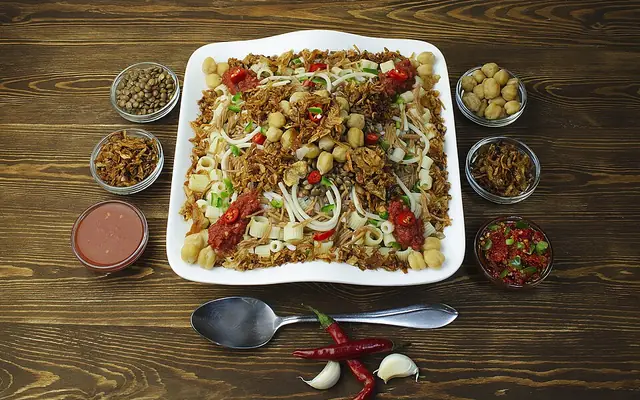
The defining dishes are koshary (the rice-lentil-pasta-chickpea-tomato-fried-onion street stack that is the national lunch), ful medames (slow-cooked fava beans with lemon, cumin, and olive oil that is the national breakfast), ta'ameya (the Egyptian falafel, made from fava beans rather than chickpeas), and molokhia (the jute-leaf soup or stew). Bread, particularly the pita-like aish baladi (bran-rich, whole wheat, baked daily and called 'aish' which means life), is the inseparable accompaniment to every meal.
The cuisine has remained surprisingly insulated from international restaurant trends, preserving a peasant-centric, bean-and-grain identity even as Cairo has globalized. Coastal Alexandria has its own seafood-and-Mediterranean inflection, and the Coptic Christian community keeps an ancient fasting cuisine (largely vegan, due to Lent and other extensive fasts) alive. Street food culture is one of the country's strengths: koshary carts, ta'ameya stalls, and ful tureens operate around the clock in central Cairo, and the call to the kushari (the cook at a koshary house) is part of the city's everyday sound. A visitor who eats only at hotel restaurants in Egypt misses essentially the entire cuisine; the food lives in the markets, the carts, and the small neighborhood spots.
Book a food experience
Tours, tastings and classes from the cities on this page, bookable on GetYourGuide.
Enjoy a guided tour and tasting in the vault of world's most famous Scotch whisky collection. Discover the art of blending and the secrets of single...
Tahrir on Bondegatan in Stockholm's Södermalm runs an Egyptian-Swedish falafel kitchen; the falafel-in-pita at 95 kronor is one of the cheapest sit-down.
TryFalafel-in-pita lunch
TipClosed Sunday. Takeaway window faster than the dining-in queue.
Koshari Street's Egyptian street-food counter on St Martin's Lane in Covent Garden London, opened 2014, runs the canonical Cairo bus-station dish at £8 a box.
Tahrir on Bondegatan in Stockholm's Södermalm runs an Egyptian-Swedish falafel kitchen; the falafel-in-pita at 95 kronor is one of the cheapest sit-down.
TryFalafel-in-pita lunch
TipClosed Sunday. Takeaway window faster than the dining-in queue.
Koshari Street's Egyptian street-food counter on St Martin's Lane in Covent Garden London, opened 2014, runs the canonical Cairo bus-station dish at £8 a box.
Dubai1 place
Koshary Abu TarekLondon1 place
Koshari StreetNantes1 place
Beau RêveStockholm1 place
Tahrir Falafel
Regional variations
Cairo and the Delta
Koshary, ful, ta'ameya, hamam mahshi (stuffed grilled pigeon, a Cairo specialty), and the strong tea-and-shisha culture of the ahwa coffee houses. The bulk of the country's restaurant identity.
Alexandria and the Mediterranean coast
Seafood-led, with grilled fish, fish stews (sayadeyya, fish-and-rice with caramelized onion), shrimp tagen, and the lingering Greek and Italian influences of the cosmopolitan pre-Nasser era.
Upper Egypt / Sa'eed
Heavier meat cooking, especially lamb and pigeon, with simpler bread-and-stew table. Fata (bread-and-broth-and-rice celebration dish) is the regional flagship.
Coptic Christian fasting cuisine
Roughly 200 days a year of Lent and other fasts produce a vegan tradition of bean dishes, pickled vegetables, foul mudammas variations, and dried-fruit desserts that has shaped the modern vegetarian-leaning Egyptian table.
Defining egyptian dishes
Koshary
The Egyptian national street dish: a stack of rice, brown lentils, macaroni, vermicelli, chickpeas, topped with crisp-fried onions, tomato sauce, and a vinegar-garlic dressing. Served with a side of chile-vinegar. Vegan, filling, ubiquitous.
Ful medames
Slow-cooked dried fava beans (often overnight in a tall qedra pot), seasoned with cumin, lemon, garlic, olive oil, chopped tomato, and parsley. The national breakfast, eaten with aish baladi bread.
Ta'ameya
Egyptian falafel, made from soaked dried fava beans (not chickpeas) ground with parsley, cilantro, coriander, cumin, and leek or scallion, then deep-fried. Greener inside than Levantine falafel, often coated in sesame seeds.
Molokhia
Jute-leaf stew, finely chopped and cooked in a chicken, rabbit, or beef broth with garlic and coriander. Served over rice with bread. The texture is famously slimy, like okra; the flavor is grassy and deeply savory.
Mahshi
Stuffed vegetables: zucchini, eggplant, cabbage leaves, vine leaves, peppers, all filled with rice, herbs, and sometimes minced meat, then simmered in tomato broth.
Hamam mahshi
Pigeon stuffed with freekeh (toasted green wheat) or rice and grilled. A Cairo specialty and celebration dish, particularly around Sayyeda Zeinab.
Fattah
Layered celebration dish of toasted bread, rice, meat (usually lamb or beef), and tomato-vinegar-garlic sauce. Eaten at Eid al-Adha and major occasions.
Sayadeyya
Fish-and-rice dish from Alexandria with caramelized onion, cumin, and sometimes turmeric. The rice cooks in the fish stock and takes on a deep amber color.
Aish baladi
The Egyptian flatbread, made from coarse whole wheat and bran, with a hollow pocket. Baked daily in neighborhood bakeries and subsidized by the government. The name 'aish' means 'life.'
Bissara
Pureed fava bean dip with garlic, cumin, parsley, and olive oil, served as part of a mezze spread. The Egyptian cousin of hummus.
Konafa
Shredded phyllo soaked in syrup with cream, cheese, or nuts in the middle. Standard Levantine-Egyptian dessert; the cream-filled version (konafa bil ashta) is particularly Egyptian.
Om Ali
Egyptian bread pudding with milk, cream, raisins, nuts, and coconut, baked until golden. Named after the wife of a 13th-century sultan; the country's signature dessert.
How to order
A koshary lunch is straightforward: walk into a koshary house, sit, and the bowl is brought. The dressings (tomato sauce, vinegar-garlic, chile-vinegar) are on the table, and you adjust to taste. Ful and ta'ameya are typically a breakfast or street-food order, in pita with tahini and salad. At a sit-down Egyptian restaurant, the mezze opens with bissara, baba ghanoush, mahshi, and salads, followed by molokhia or a stuffed pigeon. Tea or hibiscus drink closes the meal.
The rookie mistakes: under-dressing the koshary (the sauces are not optional, they are the dish), declining the chile-vinegar (it lifts everything), being put off by molokhia's slimy texture (it is the point), assuming Egyptian and Levantine cuisines are interchangeable (they share some dishes but Egypt's bean-and-grain core is distinct), and skipping the breakfast (the Egyptian ful-and-ta'ameya breakfast is one of the best vegetarian meals in any cuisine and worth structuring travel around). Coffee is Turkish-style, sweetened in the pot, and served thick; ask for sada (no sugar) or aal-rishaa (light) if you do not want a heavy dose.
What to drink with it
Tea, served strong and very sweet, is the universal table drink. Hibiscus (karkadeh), drunk hot in winter and cold in summer, is the second national beverage. Egyptian beer (Stella, Sakara) is widely available outside religious neighborhoods and pairs well with grilled food. Boza, the fermented millet drink, is a traditional but increasingly rare option. With koshary, water and a squeeze of chile-vinegar is the standard companion. Egyptian wine is limited but improving, with the Gianaclis label producing reds and whites that work with mezze.
Where to eat it
Cairo is the unquestioned center, with koshary houses (Abou Tarek is the famous tourist anchor, but neighborhood spots match it), ful carts, ta'ameya shops, and the great mezze restaurants of Zamalek and Maadi. Alexandria for seafood and the Mediterranean-Egyptian inflection. Outside Egypt, the Egyptian diaspora kitchen is small but present in New York (Bay Ridge), London, and increasingly Dubai. The cuisine has not traveled as widely as Lebanese or Moroccan, which makes Egypt itself the essential trip.
A short history
Egyptian cuisine has the longest documented continuous history of any food tradition, with bread, beer, fish, and bean recipes recorded on tomb walls and papyri going back to the Old Kingdom (c. 2700 BCE). The modern dish vocabulary took shape under Ottoman and then British rule, with koshary itself emerging in the late 19th century from a fusion of Italian pasta, Indian-British lentils, and Egyptian rice. The cuisine is one of the most vegetable-and-legume-led in the world.
Frequently asked
Is Egyptian food the same as Lebanese or Levantine?
Overlap, not equivalence. Egypt shares some dishes (hummus, baba ghanoush, kebab) with the Levant, but the core of Egyptian cooking, koshary, ful, ta'ameya, molokhia, mahshi, is its own bean-and-grain tradition with a distinct flavor profile and very different breakfast and street-food culture.
Why is Egyptian falafel green inside?
Egyptian ta'ameya is made from fava beans (not chickpeas like the Levantine version) and ground with a large quantity of fresh parsley, cilantro, and dill. The fava beans and herbs give the inside a pronounced green color.
Is koshary really vegan?
Yes, the dish itself is rice, lentils, macaroni, vermicelli, chickpeas, fried onions, tomato sauce, and a vinegar-garlic dressing. No animal products. It became the working-class lunch of Cairo partly because it is cheap, filling, and (incidentally) suitable for the long Coptic fasting calendar.