
Cambodian cuisine (Khmer cuisine) is the food of Cambodia, often grouped with Thai and Vietnamese for geographical convenience but built on a distinct technique base. The defining grammar is freshwater fish from the Mekong and the Tonle Sap lake (the world's largest freshwater fishery by season-adjusted yield), fermented fish paste (prahok), the kroeung spice paste, palm sugar, and aromatic herbs (lemongrass, kaffir lime leaf, galangal, turmeric, garlic). Cambodian cooking uses less chile than Thai cuisine and less fish sauce than Vietnamese, occupying its own distinct flavor zone.
Kroeung is the foundational paste of Khmer cuisine, the equivalent of a Thai curry paste but with regional variations. Yellow kroeung (the most common) uses lemongrass, turmeric, kaffir lime zest, galangal, garlic, and shallot. Red kroeung adds dried chile. Green kroeung uses fresh green herbs. Black kroeung uses charred shallot and lemongrass. Each kroeung produces a different family of dishes; an experienced Khmer cook will run two or three different kroeungs in service simultaneously.
Prahok (fermented fish paste) is the umami base of Cambodian cooking, distinct from Thai pla ra or Vietnamese mam ca. It is made from small mud fish caught at the end of monsoon season, salted and fermented for months. The pungency is intense to outsiders but provides a deep savory background to soups, dips (prahok ktis), and braises. Cambodian cuisine without prahok is structurally incomplete. The cuisine also has a strong rice tradition (Cambodia is the world's largest exporter of fragrant jasmine rice), a complex dessert and sweets repertoire (often coconut-based, sold from carts at markets), and a robust street-food scene that has rebuilt rapidly since the late 1990s.
Book a food experience
Tours, tastings and classes from the cities on this page, bookable on GetYourGuide.


Top picks
The best-scored Cambodian place in each of 6 cities.
Phnom Penh Noodle House ★ 4.6
Phnom Penh Noodle House in Seattle: cambodian room. Tourists charge past on Jackson Street toward The Boat; the Sam family's Cambodian kitchen sits one.
Why locals goTourists charge past on Jackson Street toward The Boat; the Sam family's Cambodian kitchen sits one block south and rarely makes guidebooks.
TipClosed Monday and Tuesday; bai sach chrouk sells out by 14:00 on weekends.
Apsara ★ 4.5
Apsara is providence's quietest Cambodian kitchen sits in a public street strip mall well off any visitor map; the food runs khmer, vietnamese, thai and lao.
Why locals goProvidence's quietest Cambodian kitchen sits in a Public Street strip mall well off any visitor map; the food runs Khmer, Vietnamese, Thai and Lao.
TipClosed Wednesdays. Order the nime chow with peanut sauce and a fiery Singapore noodle.
Phnom Penh Restaurant ★ 4.5
Phnom Penh on West 25th Street across from the West Side Market, a family-run Cambodian BYOB room, runs cheap noodle bowls, curries and the city's pho.
TryCambodian noodle and rice plates
Naga Bistro ★ 4.4
Naga Bistro in Atlanta's Chamblee is the 2025 Lao-Thai-Khmer follow-up from Snackboxe owner Thip Athakhanh: prahok ktis, khao poun and Cambodian small plates.
OrderPrahok ktis with crudite and a bowl of khao poun.
Why locals goFrom owner Thip Athakhanh of Snackboxe Bistro; opened quietly in Chamblee in 2025 serving the rarest Cambodian dishes in metro Atlanta.
TipOrder the prahok ktis (fermented-fish and pork dip) with crudite; it's the dish Atlanta doesn't have anywhere else.
Battambang ★ 4.2
Battambang on Broadway in Oakland's Chinatown has cooked Cambodian cuisine since 1993. Beef lok lak and amok lead a menu locals have leaned on for years.
SignatureBeef lok lak, Amok, Cambodian noodles
Chez Sovan ★ 4.1
Chez Sovan is a beloved San Jose weekday lunch institution offering rare authentic Cambodian fish curries, kebabs, and Khmer dishes at low prices.
OrderFish amok and slow-cooked Cambodian curry with rice
Find a place
Phnom Penh Noodle House ★ 4.6
Phnom Penh Noodle House in Seattle: cambodian room. Tourists charge past on Jackson Street toward The Boat; the Sam family's Cambodian kitchen sits one.
Why locals goTourists charge past on Jackson Street toward The Boat; the Sam family's Cambodian kitchen sits one block south and rarely makes guidebooks.
TipClosed Monday and Tuesday; bai sach chrouk sells out by 14:00 on weekends.
Apsara ★ 4.5
Apsara is providence's quietest Cambodian kitchen sits in a public street strip mall well off any visitor map; the food runs khmer, vietnamese, thai and lao.
Why locals goProvidence's quietest Cambodian kitchen sits in a Public Street strip mall well off any visitor map; the food runs Khmer, Vietnamese, Thai and Lao.
TipClosed Wednesdays. Order the nime chow with peanut sauce and a fiery Singapore noodle.
Phnom Penh Restaurant ★ 4.5
Phnom Penh on West 25th Street across from the West Side Market, a family-run Cambodian BYOB room, runs cheap noodle bowls, curries and the city's pho.
TryCambodian noodle and rice plates
Naga Bistro ★ 4.4
Naga Bistro in Atlanta's Chamblee is the 2025 Lao-Thai-Khmer follow-up from Snackboxe owner Thip Athakhanh: prahok ktis, khao poun and Cambodian small plates.
OrderPrahok ktis with crudite and a bowl of khao poun.
Why locals goFrom owner Thip Athakhanh of Snackboxe Bistro; opened quietly in Chamblee in 2025 serving the rarest Cambodian dishes in metro Atlanta.
TipOrder the prahok ktis (fermented-fish and pork dip) with crudite; it's the dish Atlanta doesn't have anywhere else.
Battambang ★ 4.2
Battambang on Broadway in Oakland's Chinatown has cooked Cambodian cuisine since 1993. Beef lok lak and amok lead a menu locals have leaned on for years.
SignatureBeef lok lak, Amok, Cambodian noodles
Chez Sovan ★ 4.1
Chez Sovan is a beloved San Jose weekday lunch institution offering rare authentic Cambodian fish curries, kebabs, and Khmer dishes at low prices.
OrderFish amok and slow-cooked Cambodian curry with rice
Cambodian by city







Regional variations
Phnom Penh and central Cambodia
The most refined and most cosmopolitan tradition. Amok trei (steamed fish in coconut-kroeung sauce), num banh chok (rice noodles in fish-curry broth), Khmer red curry (lighter than Thai), and the deepest street-food scene. The modern Phnom Penh restaurant scene leads the rebuild of Khmer fine dining.
Siem Reap (north)
Tourist-driven food scene with strong upscale Khmer (Cuisine Wat Damnak, Embassy) alongside the night-market noodle stalls. Tonle Sap freshwater fish features heavily. Banh chok and fish amok are the local headlines.
Battambang and the northwest
Closer to Thai border cuisine. More chile, more fermented seafood, and a stronger rice-paper tradition that overlaps with Vietnamese cooking. Khmer-Vietnamese hybrid dishes appear here more than elsewhere.
Kampot and the south coast
Seafood-heavy. Kampot pepper (the protected-origin pepper considered among the world's best) flavors the regional cuisine. Crab with Kampot pepper is the signature dish. Coastal cooking with more saltwater fish than freshwater.
Defining Cambodian dishes
- Amok Trei
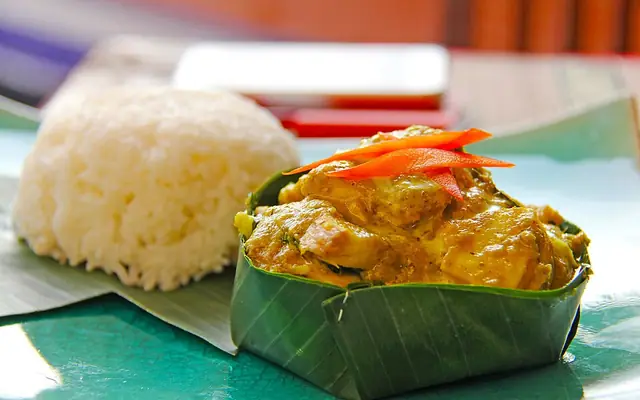
- Steamed freshwater fish in a coconut-cream-kroeung curry, presented in a banana leaf cup or coconut shell. The Cambodian national dish. Traditionally made with snakehead fish (trei ros).
- Num Banh Chok
- Cold rice noodles in a green fish-and-coconut curry broth, topped with raw banana flower, cucumber, mint, bean sprouts, and lime. The Cambodian breakfast noodle, sold from morning markets.
- Kuy Teav
- Pork-and-noodle soup with rice noodles, slow-cooked pork, blood cubes, fried garlic, scallion, fresh herbs, and bean sprouts. The Phnom Penh breakfast staple, similar to but distinct from Vietnamese pho.
- Lok Lak
- Marinated cubed beef stir-fried with onion, served on lettuce with a black-pepper-lime dipping sauce and a fried egg over rice. French colonial influence; one of the most accessible Cambodian dishes for newcomers.
- Prahok Ktis
- Pork and prahok-based dip with coconut cream, eggplant, and kroeung, served with raw vegetables for dipping. The cabinet of Cambodian flavors in one bowl.
- Bai Sach Chrouk
- Grilled marinated pork over broken rice with pickled vegetables, cucumber slices, and a clear chicken or pork broth on the side. The Cambodian breakfast counter to Vietnamese com tam.
- Khmer Red Curry (Samlor Kari)
- A milder, more aromatic red curry than the Thai version, made with chicken, sweet potato, taro, and lemongrass-galangal-turmeric kroeung. Served with rice or rice noodles.
- Nom Krok
- Coconut rice cakes cooked in a small dimpled pan, sweet on top and savory on the bottom. A market-stall snack.
- Cambodian Beef Sausage (Twa Ko)
- Pork-and-beef sausage with lemongrass, kaffir lime leaf, and red kroeung, grilled over charcoal. Served with sticky rice and chile sauce.
- Kdam Chaa
- Stir-fried crab with green Kampot pepper, garlic, and oyster sauce. The southern-coast signature, served at Kep's crab market.
How to order
At a Cambodian restaurant, family-style ordering applies. Start with one or two appetizers (prahok ktis with raw vegetables, fish sauce salad), then a curry (amok or red curry), a stir-fry or grilled dish (lok lak, twa ko), a soup or noodle dish, and rice. Tonle Sap freshwater fish is the local protein; mention amok trei or any of the freshwater fish stir-fries. Specify spice tolerance; Cambodian cooking is milder than Thai, but kitchens accommodating tourists can run hot. Cash is still common at street stalls; cards work at sit-down restaurants in Phnom Penh and Siem Reap. Tipping 5-10% at sit-down places. The rookie mistakes are skipping prahok-based dishes (the fermentation is intense but the dish itself is balanced), expecting Thai-level spice (Cambodian is mid-spicy at most), and confusing Cambodian noodle dishes with Vietnamese or Thai (they are distinct).
What to drink with it
Cambodian beer is the universal pair: Angkor, Cambodia, Anchor, and the rising craft scene. Sugarcane juice with lime is the daytime non-alcoholic option. Iced coffee (cafe khmer) with condensed milk is the everyday drink, similar to Vietnamese style but with a distinctly local roast. Palm wine (tnaot chu) is the traditional alcoholic drink, made by tapping palm trees. Wine pairing is rare; if attempted, off-dry whites or rosé work with the curry-heavy cuisine.
Where to eat it
Phnom Penh holds the deepest in-country Cambodian food scene. Cuisine Wat Damnak (now Embassy, owned by Joannes Riviere) was the modern flagship; Romdeng, Friends, and Khmer Surin lead the current scene. Siem Reap for the tourist-oriented upscale Khmer (Embassy, Pou Restaurant, Mahob). Kampot and Kep for coastal cooking and crab. Battambang for the northwestern regional cuisine. Outside Cambodia, the Cambodian diaspora has built strong food scenes in Long Beach (the largest Cambodian community outside Cambodia, sometimes called Cambodia Town), the Bay Area, Lowell Massachusetts, and Paris. London has a small but growing scene (Lemongrass).
A short history
Cambodian cuisine took shape across centuries as the Khmer Empire (9th to 15th century) dominated Southeast Asia and influenced what became Thai and Lao cooking. The French colonial period (1863-1953) added baguette, coffee, and a few pastry traditions. The Khmer Rouge period (1975-1979) catastrophically disrupted the cuisine; an estimated 1.7-2 million Cambodians died and many food traditions were lost or fragmented. The post-1990s rebuild is ongoing; the current Cambodian fine-dining scene is largely a project of the 2010s, led by chefs like Luu Meng (Malis) and the late Joannes Riviere (Cuisine Wat Damnak).
Frequently asked
Is Cambodian food the same as Thai or Vietnamese?
No. Khmer cuisine has its own grammar: the kroeung spice pastes, prahok fermented fish, milder chile use, and the freshwater fish focus from the Mekong and Tonle Sap. It shares some ingredients with Thai (lemongrass, kaffir lime, fish sauce) but uses them differently. Cambodian dishes are generally less sweet than Thai and use less fresh herb than Vietnamese.
What is kroeung?
Kroeung is the foundational Cambodian spice paste, similar to Thai curry paste but with regional variations. Yellow kroeung (lemongrass, turmeric, garlic, kaffir lime, galangal) is the most common; red kroeung adds dried chile; green kroeung uses fresh herbs; black kroeung uses charred aromatics. Each produces a different family of dishes.
Is amok trei worth ordering for first-time visitors?
Yes. Amok is one of the most accessible Cambodian dishes for non-Cambodian palates: the coconut and kroeung produce a balanced curry without aggressive spice or fermentation. It is also genuinely the national dish and a fair representation of Khmer technique. The freshwater fish is the local protein; the same dish with chicken (amok sach moan) is also common.
More cities are in research. Want Cambodian covered somewhere specific? Tell us where you want to eat.