How Ottawa came to eat the way it does: the people, migrations and accidents that shaped the plate.
Key eras
-
Before 1800: Algonquin lands and maple sap
Algonquin people have lived along the Ottawa River since at least 500 CE, meeting at Chaudière Falls, which they called Akikodjiwan, to socialize and trade. First Nations peoples have harvested and boiled sap from maple trees to make syrup since time immemorial, long before Europeans arrived in the region.
-
1800 to 1855: timber, the canal and Bytown
Philemon Wright founded Hull by Chaudière Falls in 1800, hoping to farm, but timber proved more profitable. Bytown was founded in 1826 for the building of the Rideau Canal by a workforce of English, French, Irish and Scottish workers, and the ByWard Market takes its name from the old By Ward, named after the engineer John By.
Taste it todayByWard Market -
1855 to 1960: capital city, Lower Town and Little Italy
Bytown took the name Ottawa in 1855. Lower Town, around the market, was mostly French, Irish and Catholic, and Italian immigrants settled Little Italy around 1900. Parkdale Market opened in 1924, and in the early 1940s, when Ontario bars closed at 1 am and Quebec's at 3 am, Ottawans crossed the bridge to Hull's bars.
-
1970s to 1990s: BeaverTails, Winterlude and Lebanese Ottawa
Italian Week has been celebrated on Preston Street every year since 1975. BeaverTails were first sold at a Killaloe fair in 1978 and reached the ByWard Market two years later; Winterlude began in 1979. The Ottawa Lebanese Festival was established in 1990, and Shawarma Palace has been a local institution since 1997.
-
2000s to today: the Shawarma Capital
In February 2009 Barack Obama bought a BeaverTail and maple leaf cookies in the ByWard Market, which became known as Obama cookies. By 2021 a quarter of residents had been born abroad, Lebanon among the top countries, and in 2024 City Council declared Ottawa the Shawarma Capital of Canada.
Immigrant influences
- First Nations
- Peoples who lived in this region have harvested and refined sap from sugar, red and black maple trees since long before Europeans arrived.
- French Canadian
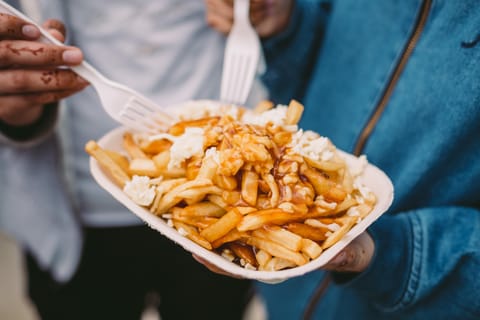
- As a city with French-Canadian roots, Ottawa serves poutine throughout, and Vanier's francophone culture keeps the country's only urban sugar shack.
- Irish
- Irish workers helped build the Rideau Canal, Lower Town was mostly French, Irish and Catholic, and the ByWard Market area was a focal point for both communities.Taste it todayByWard Market
- Italian
- Italian immigrants settled Little Italy around 1900; today family-run restaurants on Preston Street serve Italian comfort food, pasta, pizza and gelato.
- Lebanese
- A large Lebanese diaspora made shawarma, with garlic potatoes and fattoush, an Ottawa staple, and food writers link Ottawa-style pizza to its Lebanese pizza tradition.
- Chinese and Vietnamese
- China is the top country of origin of Ottawa's immigrants; Chinatown on Somerset Street serves dim sum and noodle houses alongside pho and banh mi.
- Finnish
- In 1940 a family that escaped the Winter War in Finland brought the recipe for the Sugar Munkki doughnut to Ottawa; SuzyQ Doughnuts makes it today.Taste it todaySuzyQ Doughnuts
- Syrian
- Since 2020 the family-run Jasmine Bakery has brought the flavours of Homs to Ottawa, with charcoal-cooked shawarma in house-baked bread.
Signature innovations
- BeaverTails, hand-stretched fried dough pastries, first sold in 1978 and in the ByWard Market two years later.Taste it todayByWard Market
- The Obama Cookie, a maple leaf cookie from Le Moulin de Provence, named after a presidential stop in 2009.
- The Obama Tail: a cinnamon and sugar BeaverTail with maple eyes and a Nutella O, made for the same visit.
- Ottawa-style pizza: greasy and crispy, with a sweeter sauce, thick crust and toppings under the cheese.Taste it todayOttawa-style pizza
- Art-Is-In Bakery's O-Towner, a cronut that crosses a croissant with a doughnut.
- In 2024 City Council declared Ottawa the Shawarma Capital of Canada in a unanimous motion.Taste it todayShawarma
Book food experiences in Ottawa