

The plates that define Brussels: what they are, where they came from, and where to eat the canonical version.
Signature dishes
-
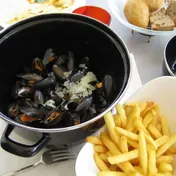
Moules-frites ★ 4.7
Mussels steamed in a pot with celery, onion, white wine, butter or cream and served with a side of fries. Moules-frites is counted as Belgium's national dish.
Where to try it: Chez Leon, Aux Armes de Bruxelles, Au Stekerlapatte
Price: €30 to €34
Moules-frites is thought to have begun on the Flemish coast, where mussels were cheap and fried potatoes were a common winter food; much of the Belgian supply comes from Zeeland farms. Chez Leon says Leon Vanlancker moved to 18 Rue des Bouchers in 1893 and that after the 1958 World Fair Brussels became the capital of moules-frites. Aux Armes de Bruxelles says it had Yerseke mussels sent to Brussels and served in individual pots in the 1920s.
Watch out for: Shellfish
-
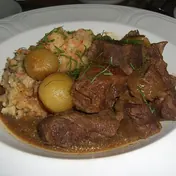
Carbonnade flamande ★ 4.6
Flemish stew of beef or pork braised in beer with onions and mustard, the sauce sometimes thickened with bread. Served with fries, boiled potatoes or stoemp.
Where to try it: Au Stekerlapatte, Chez Leon, Au Vieux Saint Martin, Aux Armes de Bruxelles
Price: €23 to €30
Carbonnade flamande, called stoofvlees or stoverij in Dutch, is made across Belgium, the Netherlands and French Flanders, and recipes vary by region and household. In East and West Flanders dried prunes are often added, and gingerbread or speculaas can replace the bread. In Brussels Au Stekerlapatte cooks it with Chimay Bleue, Au Vieux Saint Martin with Boon gueuze on mustard toast, and Chez Leon and Aux Armes de Bruxelles list it on their cards.
Watch out for: Gluten, Mustard
-
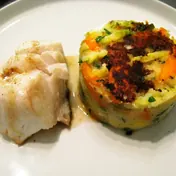
Stoemp ★ 4.4
Mashed potatoes blended with vegetables such as carrots, leeks or onions, sometimes with cream or bacon, served with fried sausage, boudin or bacon.
Where to try it: Au Stekerlapatte, Chez Leon
Price: €26
Stoemp is a Flemish dish found in Belgium, northern France and the Netherlands, and the name comes from Brabantian dialect. It is a simple, rural dish of mashed potatoes with one or more vegetables, seasoned with thyme, nutmeg or bay, and is traditionally served with fried boudin, braadworst or bacon. Wortelstoemp, made with carrots, may also contain egg yolk. In Brussels Au Stekerlapatte lists country sausage with the stoemp of the day, and Chez Leon a stoemp of the day with bacon or sausage.
Watch out for: Dairy
Book food experiences in Brussels


-
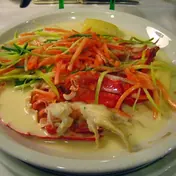
Waterzooi ★ 4.4
Creamy stew of chicken or fish with carrots, leeks, celery and potatoes in a broth thickened with egg yolk and cream. A Ghent dish found on Brussels menus.
Where to try it: Chez Leon, Au Vieux Saint Martin, Aux Armes de Bruxelles
Price: €24 to €32
Waterzooi is a soup or stew from Flanders, often called Gentse waterzooi after Ghent. The original was made with fish, often freshwater, and chicken is more common today; every version rests on a base of egg yolk, cream and thickened vegetable broth. In Brussels Chez Leon serves a Ghent waterzooi of chicken and a fish waterzooi, Au Vieux Saint Martin a Ghent waterzooi with farm chicken, and Aux Armes de Bruxelles a fish waterzooi of cod, sole, salmon and grey shrimp.
Watch out for: Eggs, Dairy
-
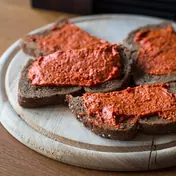
Filet americain ★ 4.5
Raw beef, finely minced and seasoned with egg yolk, mustard, capers and onion, served with fries. A Belgian cousin of steak tartare on brasserie menus.
Where to try it: Au Vieux Saint Martin, Chez Leon, Aux Armes de Bruxelles, Au Stekerlapatte
Price: €26 to €29
Au Vieux Saint Martin says its ancestor Joseph Niels, who worked at the Savoy Hotel in London, invented the recipe in 1924 by standardising the steak tartare that waiters mixed at the table, and its menu still credits him. Albert Niels opened the restaurant on the Grand Sablon in 1968, so the dish is older than the address. In Belgium the name covers americain nature, served plain or seasoned at the table, and the prepared version. Chez Leon, Aux Armes de Bruxelles and Au Stekerlapatte list it too.
Watch out for: Eggs, Mustard
-

Gaufre de Bruxelles ★ 4.5
The Brussels waffle: light, crisp and rectangular, with deep pockets, leavened with whisked egg whites or yeast. Served warm with icing sugar, cream or fruit.
Where to try it: Maison Dandoy, Au Vieux Saint Martin, Au Stekerlapatte
Price: €10 to €13
Brussels waffles are made with a batter leavened with egg whites or yeast, and are lighter and crisper than other European waffles, with larger pockets and rectangular sides that tell them from Liege waffles. The oldest reference to gaufres de Bruxelles by name dates from 1842 or 1843, from the Swiss baker Florian Dacher in Ghent. Belgian waffles were shown at Expo 58 in Brussels and popularised in the United States at the 1962 and 1964 fairs. Maison Dandoy, open since 1829, sells Brussels and Liege waffles at its Rue Charles Buls shop.
Watch out for: Gluten, Dairy, Eggs
-
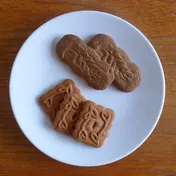
Speculoos ★ 4.6
Crunchy brown-sugar biscuit baked with real butter, cloves and cinnamon in wooden moulds. Maison Dandoy has baked it since 1829 and sells it by the box.
Where to try it: Maison Dandoy, Maison Dandoy Rue au Beurre
Price: €9.90 per 120 g box
Modern Belgian speculoos uses caramelised sugar rather than the traditional speculaas spice mix. Maison Dandoy, founded in Brussels in 1829 and established on Rue au Beurre in 1858, is among the oldest producers still working and makes its speculoos with real butter, brown sugar, cloves and cinnamon in handcrafted wooden moulds. Speculoos are the traditional treat of Saint Nicholas on 6 December. The biscuit later gave its name to a spread, which Lotus Bakeries sells as Biscoff.
Watch out for: Gluten, Dairy
-

Mitraillette ★ 4.0
Half a baguette filled with fries, a fried burger or sausage, salad and a sauce of your choice, popular with students. Fritland sells one for €9.
Where to try it: Fritland
Price: €9
The mitraillette, French for submachine gun, is a sandwich of half a baguette with fries, fried meat such as sausage, burger or steak, and a sauce, sold at friteries and cafes. It is thought to have started in Brussels, is popular among students, and is also called an americain in northern France. Fritland, a friterie near the Stock Exchange open since 1978, builds its mitraillette with a hamburger or veggie burger, salad, onions, fries and a sauce from andalouse to samourai.
Watch out for: Gluten
-
Croquettes aux crevettes grises ★ 4.5
Croquettes of thick bechamel mixed with grey shrimp, breaded and fried. With cheese croquettes, the two most popular in Belgium, as a starter or a main.
Where to try it: Noordzee Mer du Nord, Chez Leon, Aux Armes de Bruxelles, Au Stekerlapatte, Les Brigittines
Price: €12 to €29
The two most popular croquettes in Belgium have a thick bechamel filling, either grey shrimp (garnaalkroketten) or cheese. The shrimp filling is thought to have first appeared in 1922 and became popular in the 1950s. As a main dish the croquettes are usually served with salad, fried parsley and fries. In Brussels they are on the card at the Noordzee fishbar, Chez Leon, Aux Armes de Bruxelles, Au Stekerlapatte and Les Brigittines.
Watch out for: Shellfish, Gluten, Dairy, Eggs
-
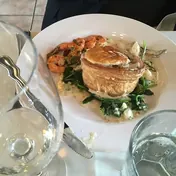
Vol-au-vent ★ 4.2
A puff-pastry case filled with chicken, mushrooms and small meatballs in a creamy sauce, served with fries or mashed potato. A common main dish in Belgium.
Where to try it: Aux Armes de Bruxelles, Au Vieux Saint Martin, Chez Leon, Les Brigittines
Price: €22 to €39
A vol-au-vent is a hollow case of puff pastry with a filling. The pastry is sometimes credited to Marie-Antoine Careme, though a recipe for petits gateaux vole au vent appears in a 1739 cookbook. In Belgium it is a common main dish on the menus of most restaurants, nearly always filled with chicken, mushrooms and small meatballs and served with fries or mashed potatoes. Aux Armes de Bruxelles serves a free-range chicken vol-au-vent, Au Vieux Saint Martin calls its version the house specialty, and Chez Leon and Les Brigittines list one too.
Watch out for: Gluten, Dairy, Eggs
-
Chicons au Gratin ★ 4.5
Belgian endives, often wrapped in ham, baked in bechamel and cheese until golden. Chez Leon lists it as a starter, Au Vieux Saint Martin as a main.
Where to try it: Chez Leon, Au Vieux Saint Martin
Price: €17 to €27
Belgian endive, called witloof or chicon, is grown in the dark so its leaves stay pale. Dutch Wikipedia records that Frans Bresiers, head of the Brussels Botanical Garden from 1826 to 1836, forced chicory in its mushroom cellar, and calls the story of an accidental discovery a popular legend. Endives au gratin in a bechamel with cheese, often wrapped in ham, is a classic Belgian dish. Chez Leon lists chicons au gratin among its starters, and Au Vieux Saint Martin serves a gratinated witloof with mashed potatoes.
Watch out for: Dairy, Gluten
-
Praline Belge ★ 4.8
Filled chocolates: a shell around ganache, caramel or nut cream. Jean Neuhaus II made the first in Brussels in 1912; the ballotin box followed in 1915.
Where to try it: Wittamer, Frederic Blondeel
Price: €27 to €67 per box
Neuhaus began in 1857 as an apothecary in the Galeries Royales Saint-Hubert, where the Swiss immigrant Jean Neuhaus coated medicines in chocolate. In 1912 his grandson Jean Neuhaus II created the first chocolate-filled bonbons, the pralines. His wife Louise Agostini and he developed the ballotin gift box in 1915 after seeing pralines crushed in paper cones. Wittamer opened on Place du Grand Sablon in 1910, and Frederic Blondeel makes pralines in his chocolate factory in Koekelberg.
Watch out for: Dairy, Tree nuts, Soy
Signature Dishes in Brussels, FAQ
What food is Brussels known for?
Brussels's signature dishes include Moules-frites, Carbonnade flamande, Stoemp, Waterzooi, Filet americain. See our signature dishes chapter for where to eat each.