History

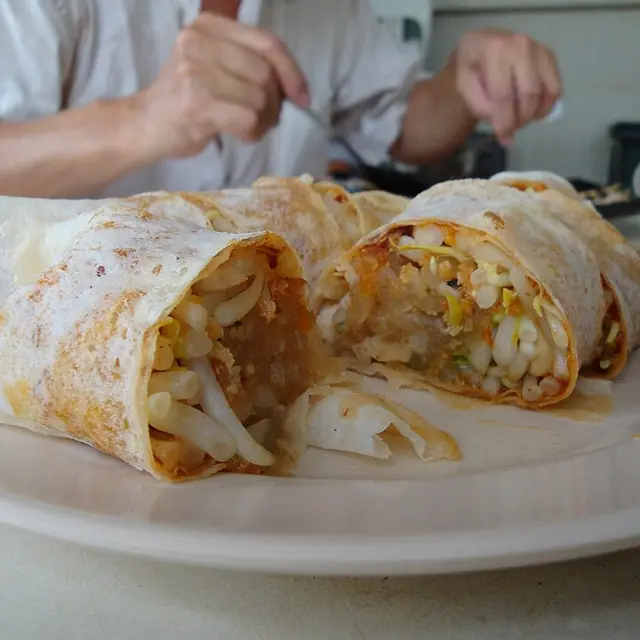
Popiah is the Hokkien fresh-spring-roll tradition brought to Singapore by 19th-century Fujianese immigrants. The dish became a Singapore Peranakan staple, particularly during the Qing Ming festival, with the assembly traditionally done at the family table from a spread of fillings. Beng Thin Hoon Kee, Kway Guan Huat in Joo Chiat (Singapore's oldest popiah-skin maker, since 1938) and the Tiong Bahru Market hawker stalls all serve the canonical version.

Common allergens: Gluten, Crustaceans, Peanut, Soy, Egg

Make it at home

Yield 12Hands-on 1 hrTotal 1 hr 30 minDifficulty Intermediate

Ingredients

  • 12 popiah skins (around 22cm diameter, available at Asian grocers; if unavailable, the closest substitute is a thin Vietnamese rice-paper wrapper, used dry)
  • For the filling: 1kg jicama (bangkuang) or daikon, peeled and grated
  • 300g pork belly, finely diced
  • 3 garlic cloves minced
  • 2 tablespoons soybean paste (taucu)
  • 2 tablespoons dark soy sauce
  • 1 tablespoon sugar
  • 300ml water
  • 200g cooked prawns, peeled and halved lengthways
  • 200g bean sprouts, blanched
  • 100g chinese chives, blanched and cut in 5cm lengths
  • 4 eggs scrambled and shredded
  • 200g firm tofu, cut in matchsticks and fried until golden
  • 100g roasted peanuts, crushed
  • 50g crispy fried shallots
  • 1 cucumber, julienned
  • Iceberg lettuce leaves
  • Sweet flour sauce (tim chiu) or hoisin
  • Chilli sauce or sambal
  • Crushed roasted garlic in oil

Method

  1. Make the filling: render the pork belly in a wok over medium heat until the fat releases. Add garlic and cook 30 seconds.
  2. Stir in the soybean paste, dark soy and sugar. Cook 1 minute.
  3. Add the grated jicama, water, and salt to taste. Cover and simmer 45 minutes until the jicama is translucent and the liquid mostly absorbed but the filling stays moist.
  4. Lay a popiah skin flat. Smear with a teaspoon of sweet sauce, then a smaller dab of chilli sauce, then crushed roasted garlic.
  5. Lay a lettuce leaf across the lower third of the skin.
  6. Spoon 2 tablespoons of the warm jicama filling onto the lettuce.
  7. Top with prawn halves, bean sprouts, chinese chives, shredded egg, crispy tofu strips, cucumber matchsticks, crushed peanuts and crispy shallots.
  8. Fold the left and right sides of the skin inwards over the filling. Roll up tightly from the bottom into a cigar shape.
  9. Slice in half on the diagonal and plate seam-down. Serve immediately while the skin is fresh.

Tip from the editors. Popiah skins are delicate; handle gently and assemble just before eating.

Where to eat popiah

Popiah in Singapore

Beng Thin Hoon Kee ★ 4.6

Chinese$$cbdDaily 11:30-14:45, 18:00-21:45

Beng Thin Hoon Kee on the fifth floor of OCBC Centres carpark is one of Singapores oldest Chinese rooms from 1949, with oyster omelette and Hokkien mee.

Why locals love it: Located on the fifth floor of a CBD carpark podium, invisible from street level and only accessible by a specific lift. No signage outside the building.

Tip: Open daily 11am to 2.30pm and 6pm to 9.30pm. Lunch is the busier of the two services; the dinner service is quieter and better for unhurried eating.

Tiong Bahru Market ★ 4.8

Cafe$tiong-bahruDaily 06:00-22:00

Tiong Bahru Market (Cafe) in Singapore: Hawker stalls open from 6am; most close by 2pm. The wet market opens at 5am. Best on weekday mornings before 10am.

Why locals love it: Tiong Bahru visitors typically go to the specialty coffee and bakery strip; the market one street over is barely mentioned in most visitor guides.

Tip: Hawker stalls open from 6am; most close by 2pm. The wet market opens at 5am. Best on weekday mornings before 10am.

More cities are in research. Want popiah covered somewhere specific? Tell us where you want to eat.

Browse all dishes →