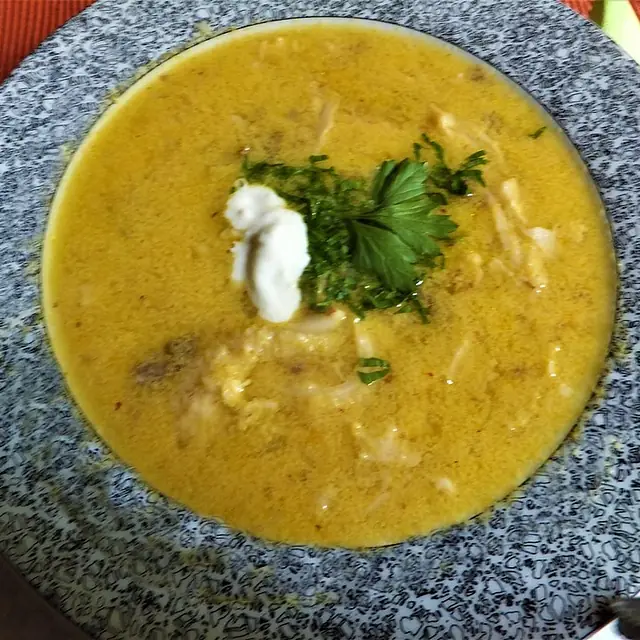
History

Ciorbă is a Romanian sour soup category, its name from the Turkish çorba ('soup'). The tripe version traces back to the Ottoman era through the Phanariot period (1711-1821), when Greek-administered princes brought Constantinople's soup-house tradition to Bucharest. Borș (wheat-bran ferment) is the older sour agent; vinegar replaced it in many city restaurants after the 1950s. The soup is a public-feast and tavern dish, the Bucharest after-hours plate.

Common allergens: Tripe, Garlic, Egg yolk

Make it at home

Yield 6Hands-on 45 minTotal 4 hr 30 minDifficulty Intermediate

Ingredients

  • 800g beef tripe (honeycomb), trimmed and cleaned
  • 1 large beef bone (with marrow)
  • 2 carrots, peeled
  • 1 parsnip, peeled
  • 1 white onion, peeled
  • 2 celeriac stalks
  • 2 bay leaves
  • 1 teaspoon black peppercorns
  • 100ml white wine vinegar (or 200ml borș)
  • 1 whole head of garlic, peeled and pureed with a little water
  • 200g smântână (sour cream)
  • 2 egg yolks
  • Salt, fresh chilli and parsley to finish

Method

  1. Bring the tripe and beef bone to a boil in 3 litres of cold water. Skim foam, then simmer for 30 minutes.
  2. Drain, rinse the tripe, and return to the pot with fresh water and the bone.
  3. Add carrots, parsnip, whole onion, celeriac, bay leaves and peppercorns. Simmer for 3 hours, partially covered, until the tripe is tender enough to slice with a spoon.
  4. Lift out the tripe and slice into thin strips; strain the broth and discard the bone and vegetables (or save the carrots).
  5. Return the broth and tripe to the pot. Stir in the vinegar (or borș) to taste, salt to season.
  6. Whisk the sour cream with the egg yolks and 200ml of warm broth; stir back into the pot off the heat to thicken without curdling.
  7. Stir in half the garlic puree; the rest goes to the table.
  8. Serve in deep bowls with the table garlic puree, fresh chilli and chopped parsley; a slice of dense rye bread on the side.

Tip from the editors. The vinegar versus borș call is regional: south-Romanian tradition uses borș, Bucharest restaurants almost always use vinegar. Either way, add the souring liquid to taste at the end, not earlier.

Where to eat ciorbă de burtă

Ciorbă de burtă in Bucharest

Caru' cu bere ★ 4.6

Traditional Romanian$$$lipscaniMon-Sun 10:00-24:00

The 1879 Caru' cu bere on Stavropoleos serves the soul of Bucharest dining, where mici were recorded in a 1920 chef's letter to the Academy.

Signature: Mici, Sarmale, Papanași

Order: Mici with mustard and ciorbă de burtă, then papanași for dessert.

Tip: Walk-up queues from 12:30 onward; the upstairs hall has the live folk band.

Crama Domnească ★ 4.1

Traditional Romanian$$lipscaniTue-Sun 12:00-24:00; Mon 14:00-24:00

Crama Domnească sits in the cellar of the Princely Court on Șelari, the Princely Wine Cellar in Bucharest, with live folk and house wines by carafe.

Signature: Sarmale, Mămăligă, Ciorbă de burtă

Order: Mămăligă with brânză and smântână; a clay-pot tochitură.

Tip: Live taraf music every evening; cash and card both accepted.

Mahala ★ 4.5

Modern Romanian$$$centru-civicMon-Sun 11:00-01:00

Chef Petru Sorin Cucu's Mahala cooks contemporary Romanian inside the Bragadiru Palace, near the House of the People, one of the boldest menus in town.

Signature: Ciorbă de burtă cu trufe, Turbot, Quail dumplings

Order: Ciorbă de burtă with black truffles; the quail-olive dumplings.

Tip: Lunch service is quieter; dinner books out Thursday to Saturday.

Hanu' lui Manuc ★ 4.4

Traditional Romanian$$$lipscaniMon-Thu 10:00-24:00; Fri-Sat 10:00-02:00; Sun 10:00-24:00

The 1808 caravanserai-turned-restaurant Hanu' lui Manuc on Franceză serves classic Romanian plates around one of Europe's last remaining inn courtyards.

Signature: Mici, Sarmale, Lamb tochitură

Order: Mici and a lamb tochitură; the cabbage rolls feed two.

Tip: The courtyard fills first; ask for a balcony table inside the U-shaped inn.

Vatra ★ 4.3

Romanian$$cismigiuMon-Sun 12:00-23:30

Vatra on Brezoianu cooks traditional Romanian on bakestones and in tin kettles, in a 1920s Transylvanian interior next to Cișmigiu Park in Bucharest.

Signature: Sarmale, Tochitură, Romanian cheese plate

Order: Sarmale with mămăligă; the cheese plate of Brașov sheep and Sibiu cow.

Tip: The veranda opens May through October; lunch fixed menu is 45 RON.

More cities are in research. Want ciorbă de burtă covered somewhere specific? Tell us where you want to eat.

Browse all dishes →