
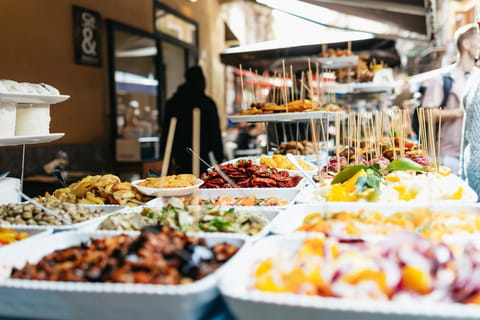
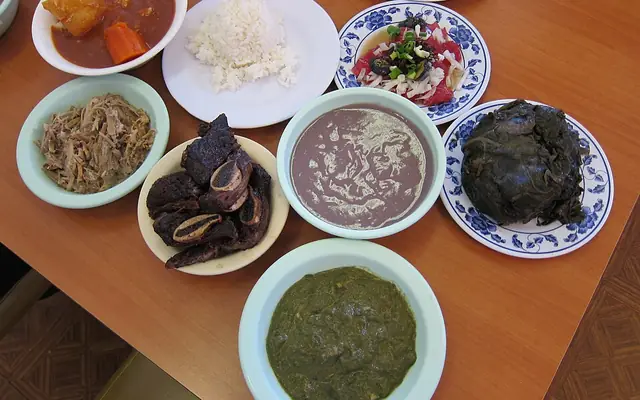
Hawaiian cuisine is the cooking of the Hawaiian islands, descended from the indigenous Polynesian foodways of the original Native Hawaiian (Kanaka Maoli) population layered with successive waves of plantation-era immigration from Japan, China, Korea, the Philippines, Portugal (specifically from the Azores and Madeira), Puerto Rico, and the American mainland. The result is one of the most fully realized fusion cuisines in the world, where a single plate lunch might combine Japanese teriyaki chicken, Korean kalbi short ribs, Portuguese sausage, and Hawaiian rice and macaroni salad without anyone considering it unusual.
The defining concept is the plate lunch, the working-class meal that emerged from the plantation era: two scoops of white rice, one scoop of macaroni salad, and a hot protein (kalua pig, teriyaki chicken, mochiko chicken, beef stew, loco moco, chicken katsu, kalbi short ribs, Spam). Plate lunch is the everyday Hawaiian meal and the cuisine's most distinctive structural format. Alongside plate lunch, the canon includes poke (raw fish marinated with soy, sesame, onion, and seaweed, covered in its own pillar), Spam musubi (a slab of fried Spam on a rice block wrapped in nori), shave ice (the snow-cone descendant with tropical fruit syrups and adzuki bean), malasadas (Portuguese doughnuts), and the imu-cooked kalua pig that anchors the luau celebration.
The distinction between Hawaiian (indigenous) and Hawaiian regional cuisine (the modern restaurant tradition) is worth noting. Roy Yamaguchi, Sam Choy, Alan Wong, and a group of chefs in the early 1990s launched 'Hawaiian regional cuisine' as a movement to apply contemporary technique to island ingredients (fresh local fish, tropical fruit, taro, sea salt, kona coffee). This high-end tradition has fed into the work of Ed Kenney, Mark Noguchi, and the current generation of Hawaiian chefs. The everyday plate-lunch culture remains the cuisine's living foundation.
Book a food experience
Tours, tastings and classes from the cities on this page, bookable on GetYourGuide.


Top picks
The best-scored Hawaiian place in each of 4 cities.
Senia ★ 4.8
Senia in Honolulu Chinatown is the modern Hawaiian tasting room that Anthony Rush and Chris Kajioka opened in 2016, now Rush-led since 2021 with stages.
OrderSmoked ahi cigars and the roasted bone marrow with three salts.
TipTasting menu runs eight to ten courses, around $135 to $160 per person before drinks. Book three weeks out via Tock.
Bali Hai Restaurant ★ 4.2
Bali Hai Restaurant in San Diego is the 1955 Shelter Island Tiki institution, with a sprawling Polynesian dining room, a boat dock and the city's most famous.
OrderThe original Mai Tai (a known-strong recipe since the 1950s); the Polynesian Platter for sharing.
TipSunday brunch is the value play; book a window for sunset over the marina and Point Loma.
Poke Hawaiian Taste ★ 4.1
Poke Hawaiian Taste is a poké restaurant at Piazza S. Francesco di Paola 3/4: build your bowl from fresh ingredients, to eat in, take away or have delivered.
OrderA poké bowl you build yourself from fresh ingredients.
TipPoké is prepared in a few minutes, so it suits a quick lunch or a dinner.
Big Kahuna ★ 4.0
Big Kahuna grills Hawaiian barbecue plates and stacked burgers on Liberty Road, the Lexington original that later added a second Clays Mill Road shop.
TipClosed Mondays at both shops; the Liberty Road original keeps the shorter queue at weekday lunch.
Find a place
Senia ★ 4.8
Senia in Honolulu Chinatown is the modern Hawaiian tasting room that Anthony Rush and Chris Kajioka opened in 2016, now Rush-led since 2021 with stages.
OrderSmoked ahi cigars and the roasted bone marrow with three salts.
TipTasting menu runs eight to ten courses, around $135 to $160 per person before drinks. Book three weeks out via Tock.
Helena's Hawaiian Food ★ 4.8
Helena's Hawaiian Food is locals queue for this 1946 kalihi institution but most visitors never venture past chinatown to north school street.
Why locals goLocals queue for this 1946 Kalihi institution but most visitors never venture past Chinatown to North School Street.
TipTuesday to Friday 10:00-19:30. Pipikaula short ribs are the must-order; the kalua pig is also canonical.
Mugen Waikiki ★ 4.7
Mugen Waikiki is the Forbes Five-Star room inside ESPACIO with a 34-seat dining room, designed in consultation with Alan Wong, anchoring fine dining.
OrderThe five-course tasting with the local-fish course and Hawaiian beef.
TipReservations open 30 days out. Resort wear is the dress code; valet at the ESPACIO motor lobby is free for diners.
Bali Hai Restaurant ★ 4.2
Bali Hai Restaurant in San Diego is the 1955 Shelter Island Tiki institution, with a sprawling Polynesian dining room, a boat dock and the city's most famous.
OrderThe original Mai Tai (a known-strong recipe since the 1950s); the Polynesian Platter for sharing.
TipSunday brunch is the value play; book a window for sunset over the marina and Point Loma.
Poke Hawaiian Taste ★ 4.1
Poke Hawaiian Taste is a poké restaurant at Piazza S. Francesco di Paola 3/4: build your bowl from fresh ingredients, to eat in, take away or have delivered.
OrderA poké bowl you build yourself from fresh ingredients.
TipPoké is prepared in a few minutes, so it suits a quick lunch or a dinner.
Big Kahuna ★ 4.0
Big Kahuna grills Hawaiian barbecue plates and stacked burgers on Liberty Road, the Lexington original that later added a second Clays Mill Road shop.
TipClosed Mondays at both shops; the Liberty Road original keeps the shorter queue at weekday lunch.
Hawaiian by city




Regional variations
Oahu (Honolulu)
The center of the modern Hawaiian food scene, with the densest plate lunch geography (L&L Hawaiian Barbecue, Rainbow Drive-In, Helena's Hawaiian Food), the strongest poke shop scene (Ono Seafood, Maguro Brothers, Foodland), and the Hawaiian regional cuisine flagships (MW Restaurant, Town, Mahina & Sun's).
Maui
The high-end resort food and the family-owned plate lunch scene, with Mama's Fish House and Star Noodle on the chef-driven side, and Da Kitchen and Tin Roof for plate lunch.
Hawaii Island (Big Island)
The deepest indigenous Hawaiian food access, with kalua pig and laulau cooked in traditional imu pits at family operations. Hilo and Kona side restaurants. Kona coffee country and grass-fed beef from the Parker Ranch.
Kauai
Smaller restaurant scene but with strong plate lunch and the original Hamura Saimin Stand (the noodle shop institution since 1952).
Defining Hawaiian dishes
- Plate lunch
- The Hawaiian working-class meal: two scoops of white rice, one scoop of macaroni salad, and a hot protein (teriyaki chicken, kalbi short ribs, kalua pig, mochiko chicken, chicken katsu, beef stew, loco moco, Hawaiian-style barbecue meats). The format is more important than any single component.
- Kalua pig
- Whole pig slow-cooked underground in an imu (Hawaiian earth oven) lined with hot stones and banana or ti leaves, then shredded with the smoky fat rendered through. The defining Hawaiian indigenous dish, served at every luau and in plate lunch form daily.
- Loco moco
- White rice topped with a hamburger patty, a fried egg, and brown gravy. Invented at the Lincoln Grill in Hilo in 1949. The defining Hawaiian comfort food and a regular plate lunch component.
- Spam musubi
- A slab of fried Spam (often glazed with teriyaki) on a block of white rice, wrapped with a strip of nori. Hawaii consumes more Spam per capita than any other US state; the musubi is the format that made it a fully integrated local food.
- Saimin
- Hawaiian noodle soup, a fusion of Chinese, Japanese, and Filipino noodle traditions, with thin wheat noodles in a clear broth topped with char siu, green onion, fish cake, and a hard-boiled egg. Hamura Saimin Stand on Kauai (since 1952) is the institutional anchor.
- Laulau
- Pork (and sometimes salted butterfish) wrapped in taro (luau) leaves and ti leaves, steamed or slow-cooked for hours. The luau leaves cook down to a spinach-like consistency and absorb the pork fat.
- Poi
- Pounded taro root mixed with water into a smooth paste, eaten fresh (sweeter) or fermented (tangier). The traditional Hawaiian starch staple, served as a side at indigenous Hawaiian meals.
- Lomi salmon
- Salted salmon (lomi means to massage) hand-mixed with diced tomato, onion, and sometimes green onion. The cold side dish at any traditional Hawaiian meal.
- Mochiko chicken
- Chicken marinated in soy, ginger, garlic, sugar, and dredged in mochiko (sweet rice flour), then deep-fried. A Hawaiian-Japanese local invention that is now a plate lunch staple.
- Kalbi short ribs
- Korean-style flanken-cut beef short ribs marinated in soy, sugar, garlic, sesame, and pear, grilled or pan-seared. A plate lunch staple, reflecting the Korean plantation immigration.
- Malasadas
- Portuguese-Hawaiian doughnuts: yeasted dough deep-fried and rolled in sugar (or filled with custard, haupia, or li hing mui). Leonard's Bakery (since 1952) is the Honolulu institution.
- Shave ice
- Finely shaved ice (not crushed) topped with tropical fruit syrups (pineapple, mango, lilikoi passionfruit, guava), often with vanilla ice cream and azuki bean at the bottom. The Hawaiian dessert.
How to order
At a plate lunch counter, choose the protein (teriyaki chicken, kalua pig, kalbi, loco moco, mochiko chicken, hamburger steak with gravy, mixed plate) and the meal arrives with two scoops of rice and one of mac salad. Most places offer a 'mini' or 'regular' size; mini is enough food. At a poke shop, order a poke bowl (rice base with one or two scoops of poke and toppings). For traditional Hawaiian food, visit a place like Helena's or Highway Inn for kalua pig, laulau, poi, lomi salmon, and squid luau on a combination plate. End with malasadas or shave ice.
The rookie mistakes: confusing 'Hawaiian' (the cuisine of the islands) with 'Hawaiian pizza' (a Canadian invention with no relation to Hawaii), refusing to try Spam (it is genuinely good in musubi form and locally beloved), expecting one scoop of rice (it is always two), and skipping poi because of the texture (it is the traditional starch and the foundation of indigenous Hawaiian eating). Tipping is 18 to 20 percent at sit-down places, 10 to 15 at counter-service plate lunch.
What to drink with it
Cold beer (Kona Brewing Company's Longboard Island Lager, Maui Brewing) is the universal Hawaiian pairing. Mai tai and other tiki cocktails (a 20th-century invention, not pre-contact Hawaiian) at the resort and bar level. Hawaiian punch (the actual fruit-juice drink) and POG (passion-orange-guava) juice for the non-alcoholic side. Kona coffee with malasadas. With poke, a crisp Sauvignon Blanc or a sake. With kalua pig, a soft red or a malt lager. Champagne and a high-end Hawaiian regional cuisine tasting menu (MW, Mahina & Sun's) are the upper register pairings.
Where to eat it
Oahu is the densest food geography: Helena's Hawaiian Food, Highway Inn, Rainbow Drive-In, L&L Hawaiian Barbecue, the food halls of Ala Moana, the local diner-and-counter culture of Honolulu and the North Shore. Maui for Mama's Fish House, Tin Roof, Da Kitchen. The Big Island for the most traditional indigenous Hawaiian access. Outside Hawaii, the cuisine appears in the diaspora cities (Los Angeles especially has a strong Hawaiian-American restaurant scene, with L&L Hawaiian Barbecue chains, Aloha Cafe, Bruddah's). Las Vegas (sometimes called 'the ninth island' for its Hawaiian community) has serious Hawaiian-style restaurants. The cuisine is harder to find outside the US.
A short history
Hawaiian cuisine emerged from the meeting of Native Hawaiian Polynesian foodways (taro, sweet potato, breadfruit, pork, fish, salt) with the immigration of Asian and European plantation workers between 1850 and 1930. Chinese, Japanese, Korean, Filipino, Portuguese, and Puerto Rican workers each brought their own foods, which fused into the plantation-era plate lunch and bento-box culture. Spam became a Hawaiian staple during WWII when fresh meat was scarce. Hawaiian regional cuisine, the modern fine-dining movement, was launched in 1991 by twelve chefs (Roy Yamaguchi, Sam Choy, Alan Wong, Peter Merriman, and others) committed to elevating local ingredients.
Frequently asked
Is Hawaiian pizza Hawaiian?
No. Hawaiian pizza (ham and pineapple) was invented in 1962 by Sam Panopoulos at the Satellite Restaurant in Chatham, Ontario, Canada. It has no connection to Hawaii. Pineapple is grown commercially in Hawaii, but the pizza is a Canadian invention.
Why do Hawaiians eat so much Spam?
WWII history. During the war, fresh meat was rationed and shipments were limited, but military bases on the islands had abundant Spam. The product became integrated into local Hawaiian-Japanese-Filipino cooking and never left. Hawaii consumes more Spam per capita than any other US state, and Spam musubi is now a foundational island snack.
What is the difference between Hawaiian food and Polynesian food?
Polynesian is the broader Pacific cultural region (Hawaii, Tahiti, Samoa, Tonga, Maori New Zealand). Pre-contact Hawaiian food (kalua pig, poi, laulau, lomi salmon) is a Polynesian cuisine. Modern Hawaiian food is heavily Asian-American influenced and distinct from Tahitian or Samoan cooking, which retained more directly Polynesian forms.
More cities are in research. Want Hawaiian covered somewhere specific? Tell us where you want to eat.